SOP: Start of Production
Chapter 11 · Automotive Product Development
Use the infographic for the process overview, then follow the chapter sections for definitions, activities, deliverables, gate evidence, and implementation detail.
Chapter infographic
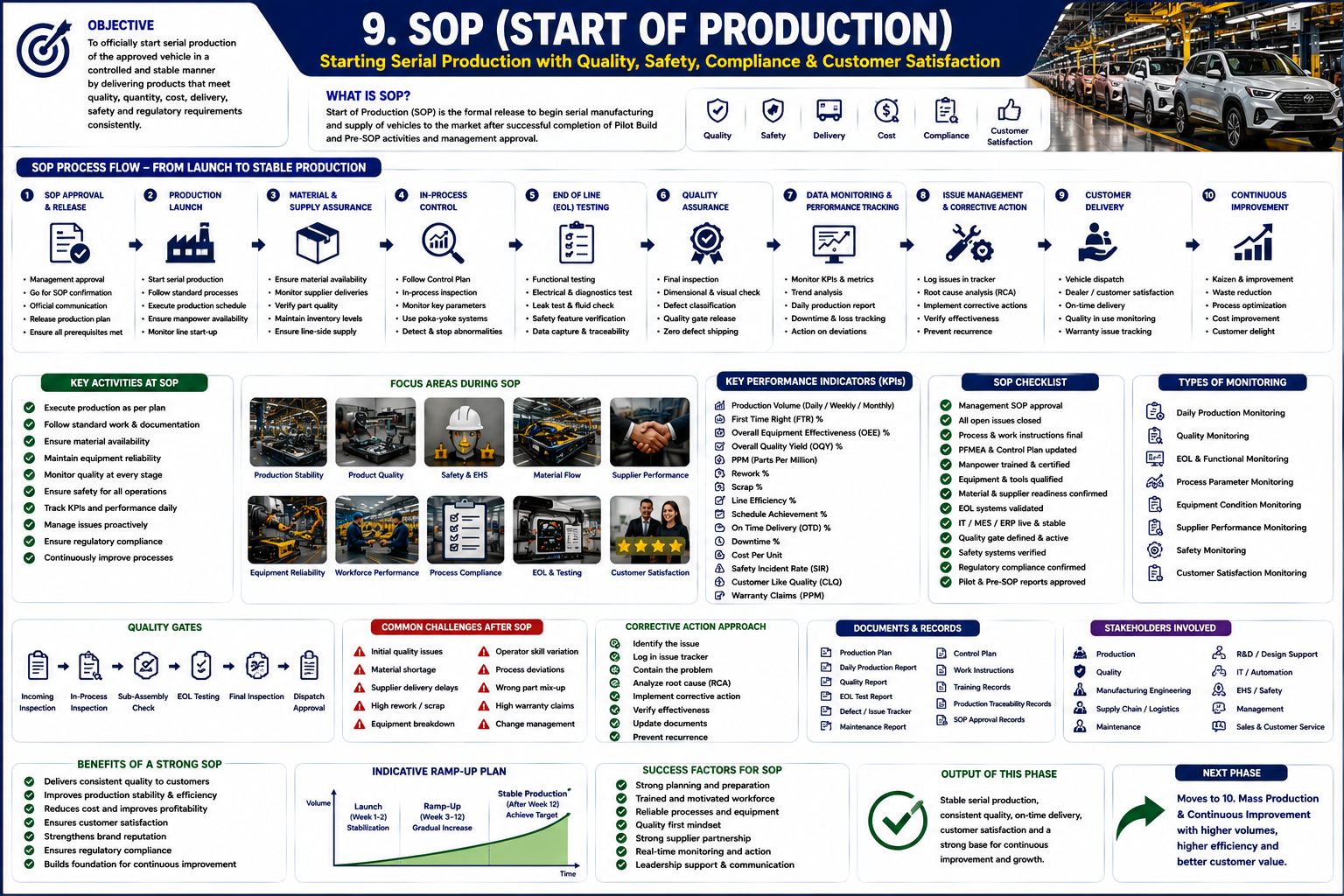
SOP – Start of Production in Automotive Product Development
Starting Serial Production with Quality, Safety, Compliance and Customer Satisfaction
SOP, or Start of Production, is one of the most important milestones in the Automotive Product Development Process. It marks the official start of serial production after successful completion of product development, validation, homologation, industrialization, pilot build and Pre-SOP activities.
At this stage, the vehicle moves from development and trial production into controlled mass production. The focus shifts from “Are we ready to produce?” to “Can we produce consistently every day with stable quality, cost, delivery and compliance?”
In simple words, SOP answers the question:
“Are we officially ready to manufacture and deliver customer-ready vehicles in a controlled and repeatable production process?”
1. What is SOP?
SOP stands for Start of Production.
It is the formal release to begin serial manufacturing and supply of vehicles to the market after successful completion of:
- Product development
- Prototype validation
- Design Validation and Product Validation
- Homologation and Type Approval
- Industrialization
- Pilot Build
- Pre-SOP validation
- Management approval
After SOP, vehicles are produced using approved production processes, trained manpower, qualified tools, released components, validated EOL systems and finalized quality controls.
2. Objective of SOP
The main objective of SOP is to officially start serial production of the approved vehicle in a controlled and stable manner.
SOP ensures that products are delivered with:
- Required quality
- Product safety
- Regulatory compliance
- Planned delivery
- Controlled cost
- Stable production process
- Customer satisfaction
SOP is not only a production start date. It is a controlled approval milestone confirming that the complete organization is ready for customer delivery.
3. SOP Process Flow – From Launch to Stable Production
The image shows a structured 10-step SOP process flow.
Step 1: SOP Approval & Release
SOP begins only after formal management approval.
Key Activities
Obtain management approval.
Confirm “Go for SOP” decision.
Issue official communication.
Release production plan.
Confirm all prerequisites are met.
Confirm open issues are acceptable or closed.
Confirm quality, process, supplier and logistics readiness.
Importance
Without formal SOP approval, serial production should not begin. SOP approval ensures that all departments agree that the product and process are ready for customer production.
Step 2: Production Launch
Production launch is the actual start of serial production on the approved production line.
Key Activities
Start serial production.
Follow standard production processes.
Execute production schedule.
Ensure manpower availability.
Monitor line start-up.
Confirm shift plan.
Confirm production volume plan.
Confirm production communication.
Key Focus
During launch, production output may be lower than the final target volume. The initial period is normally used for stabilization before full ramp-up.
Step 3: Material & Supply Assurance
Stable material supply is essential for successful SOP.
Key Activities
Ensure material availability.
Monitor supplier deliveries.
Verify part quality.
Maintain inventory levels.
Ensure line-side supply.
Track critical components.
Monitor supplier delivery performance.
Confirm alternate supply plan, if required.
Common Risks
- Supplier delay
- Wrong part delivery
- Shortage of critical parts
- Old revision parts
- Packaging damage
- Poor line-side feeding
- ERP stock mismatch
A smooth SOP requires strong coordination between production, supply chain, purchase, logistics and suppliers.
Step 4: In-Process Control
In-process control ensures that defects are detected and corrected during production itself.
Key Activities
Follow Control Plan.
Conduct in-process inspection.
Monitor key parameters.
Use poka-yoke systems.
Detect and stop abnormalities.
Verify torque, fitment, leakage and functional points.
Maintain process discipline.
Purpose
The aim is to build quality into the process rather than detecting defects only at final inspection.
Step 5: End of Line Testing
EOL means End of Line. It is the final functional and diagnostic verification before vehicle release.
Key Activities
- Functional testing
- Electrical and diagnostic testing
- Leak testing
- Fluid check
- Safety feature verification
- Data capture
- Traceability recording
- ECU / software confirmation
- OBD check, where applicable
Examples
For motorcycles:
- Lighting check
- Horn check
- Instrument cluster check
- ABS warning check
- Engine start check
- Brake test
- Noise check
For EVs:
- High-voltage safety check
- Insulation resistance test
- BMS communication check
- Charging test
- Motor controller check
- Battery status check
EOL testing is a very important gate before dispatch.
Step 6: Quality Assurance
Quality Assurance confirms that the vehicle meets internal and customer requirements before dispatch.
Key Activities
- Final inspection
- Dimensional and visual checks
- Defect classification
- Quality gate release
- Zero-defect shipping confirmation
- Customer-like quality audit
- Road test confirmation, where applicable
- Appearance and fit-finish inspection
Objective
No vehicle should be shipped unless it meets approved quality standards.
Step 7: Data Monitoring & Performance Tracking
During SOP, all key production and quality data must be monitored daily.
Key Activities
Monitor KPIs and metrics.
Conduct trend analysis.
Review daily production reports.
Track downtime and losses.
Identify abnormalities.
Take immediate action on deviations.
Monitor supplier quality.
Monitor warranty and early field feedback.
Why It Is Important
Early SOP data gives the first indication of production stability. Repeated defects, high downtime or EOL failures must be acted upon immediately.
Step 8: Issue Management & Corrective Action
Even after successful Pre-SOP, some issues may appear during SOP. These must be managed through a disciplined corrective action process.
Key Activities
Log issues in tracker.
Conduct root cause analysis.
Implement corrective actions.
Verify effectiveness.
Prevent recurrence.
Update documents, if required.
Review issue status daily.
Corrective Action Flow
- Identify issue
- Log in issue tracker
- Contain the problem
- Analyse root cause
- Implement corrective action
- Verify effectiveness
- Update documents
- Prevent recurrence
Step 9: Customer Delivery
After successful production and quality approval, vehicles are released to customers or dealers.
Key Activities
- Vehicle dispatch
- Dealer delivery readiness
- Customer satisfaction monitoring
- On-time delivery tracking
- Quality in-use monitoring
- Warranty issue tracking
- Feedback collection
Importance
SOP success is finally judged by customer experience. Even if production is smooth, poor early customer feedback can affect brand reputation.
Step 10: Continuous Improvement
SOP is not the end of improvement. It is the beginning of continuous monitoring and optimization.
Key Activities
- Kaizen activities
- Waste reduction
- Process optimization
- Cost improvement
- Quality improvement
- Productivity improvement
- Warranty reduction
- Customer delight actions
The aim is to move from launch stabilization to mature and efficient mass production.
4. Key Activities at SOP
The image highlights several important activities during SOP.
These include:
Execute production as per plan.
Follow standard work and documentation.
Ensure material availability.
Maintain equipment reliability.
Monitor quality at every stage.
Ensure safety for all operations.
Track KPIs and performance daily.
Manage issues proactively.
Ensure regulatory compliance.
Continuously improve processes.
Each of these activities is important for achieving stable production and customer satisfaction.
5. Focus Areas During SOP
Production Stability
The production line must achieve consistent output without frequent stoppages, quality issues or process instability.
Product Quality
Every vehicle must meet the approved quality standard, including function, appearance, safety and reliability.
Safety & EHS
Operator safety, machine safety, PPE usage, ergonomics, fire safety and emergency readiness must be controlled.
Material Flow
Parts must reach the correct station at the correct time in the correct quantity and revision level.
Supplier Performance
Supplier quality and delivery must be closely monitored, especially for critical and safety-related parts.
Equipment Reliability
Tools, fixtures, machines, EOL testers and conveyors must operate reliably with minimum downtime.
Workforce Performance
Operators and supervisors must follow standard work and maintain discipline during production.
Process Compliance
Control Plan, work instructions, inspection standards and quality gates must be followed strictly.
EOL & Testing
End-of-line tests must confirm that every vehicle is functionally ready before dispatch.
Customer Satisfaction
Early customer feedback, dealer feedback and warranty data must be monitored from the beginning.
6. Key Performance Indicators at SOP
SOP performance must be tracked through measurable KPIs.
These KPIs should be reviewed daily during launch and ramp-up.
7. SOP Checklist
Before and during SOP, the following checklist should be reviewed:
- Management SOP approval received
- All open issues closed or formally accepted
- Process and work instructions finalized
- PFMEA and Control Plan updated
- Manpower trained and certified
- Equipment and tools qualified
- Material and supplier readiness confirmed
- EOL systems validated
- IT / MES / ERP systems stable
- Quality gates defined and active
- Safety systems verified
- Regulatory compliance confirmed
- Pilot Build and Pre-SOP reports approved
This checklist helps avoid uncontrolled launch risks.
8. Types of Monitoring During SOP
The image shows several monitoring activities required during SOP.
Daily Production Monitoring
Tracks production output, plan achievement, shift performance and bottlenecks.
Quality Monitoring
Tracks defects, rework, scrap, quality gate performance and customer-like quality.
EOL & Functional Monitoring
Tracks EOL pass rate, diagnostic failures, functional defects and repeat failures.
Process Parameter Monitoring
Tracks torque values, pressure, temperature, cycle time, leak test values and critical process parameters.
Equipment Condition Monitoring
Tracks machine health, breakdowns, preventive maintenance and downtime.
Supplier Performance Monitoring
Tracks supplier delivery, quality, shortages and corrective actions.
Safety Monitoring
Tracks incidents, near misses, PPE usage, unsafe conditions and safety compliance.
Customer Satisfaction Monitoring
Tracks dealer feedback, customer complaints, warranty issues and field data.
9. Quality Gates During SOP
Quality gates are checkpoints used to prevent defects from moving forward.
Typical SOP quality gates include:
- Incoming Inspection
- In-Process Inspection
- Sub-Assembly Check
- EOL Testing
- Final Inspection
- Dispatch Approval
Each gate must have clear acceptance criteria and reaction plan.
For example, if an EOL electrical test fails, the vehicle should not move to dispatch until the issue is diagnosed, corrected and re-tested.
10. Common Challenges After SOP
Even after careful Pre-SOP preparation, issues may appear during early production.
Common challenges include:
- Initial quality issues
- Material shortage
- Supplier delivery delays
- High rework or scrap
- Equipment breakdown
- Operator skill variation
- Process deviations
- Wrong part mix-up
- High warranty claims
- Engineering change management issues
These challenges are normal during early ramp-up, but they must be controlled quickly.
11. Corrective Action Approach During SOP
A fast and disciplined corrective action system is required.
Corrective Action Steps
Identify the issue.
Log the issue in tracker.
Contain the problem immediately.
Analyse root cause.
Implement corrective action.
Verify effectiveness.
Update PFMEA, Control Plan, work instruction or training records.
Prevent recurrence.
Important Point
During SOP, containment is very important. If any serious issue is found, suspect vehicles or parts must be identified, segregated and inspected immediately.
12. Documents and Records Required at SOP
Proper documentation is essential for production control, quality assurance, audit readiness and traceability.
Important documents include:
- Production Plan
- Daily Production Report
- Quality Report
- EOL Test Report
- Defect / Issue Tracker
- Maintenance Report
- Control Plan
- Work Instructions
- Training Records
- Production Traceability Records
- SOP Approval Records
These records provide evidence that the production system is controlled and compliant.
13. Stakeholders Involved in SOP
SOP requires coordination across multiple departments.
Strong cross-functional coordination is essential during the SOP and ramp-up period.
14. Benefits of a Strong SOP
A well-executed SOP provides the following benefits:
- Delivers consistent quality to customers
- Improves production stability and efficiency
- Reduces cost and improves profitability
- Ensures customer satisfaction
- Strengthens brand reputation
- Ensures regulatory compliance
- Builds foundation for continuous improvement
- Reduces warranty risk
- Improves supplier discipline
- Supports smooth ramp-up
15. Indicative Ramp-Up Plan
After SOP, production volume is normally increased in phases.
Launch Phase — Week 1 to 2
Focus:
- Stabilization
- Close monitoring
- Immediate issue resolution
- Low to moderate production volume
Ramp-Up Phase — Week 3 to 12
Focus:
- Gradual volume increase
- Supplier performance monitoring
- Process efficiency improvement
- Quality stabilization
Stable Production — After Week 12
Focus:
- Target volume achievement
- Cost optimization
- Quality consistency
- Productivity improvement
- Continuous improvement
The exact timeline depends on product complexity, plant maturity, supplier readiness and market demand.
16. Success Factors for SOP
Successful SOP depends on:
- Strong planning and preparation
- Trained and motivated workforce
- Reliable processes and equipment
- Quality-first mindset
- Strong supplier partnership
- Real-time monitoring and action
- Leadership support and communication
- Fast issue escalation
- Effective quality gates
- Good customer feedback loop
17. Output of SOP Phase
The expected output of SOP is:
Stable serial production, consistent quality, on-time delivery, customer satisfaction and a strong base for continuous improvement and growth.
After this phase, the product moves to:
Mass Production and Continuous Improvement
18. Practical Example: Motorcycle SOP
For a motorcycle production line, SOP activities may include:
- Start regular vehicle assembly
- Confirm engine and frame fitment process
- Monitor torque for safety-critical fasteners
- Confirm brake hose routing
- Confirm ABS system function
- Confirm lighting and indicator check
- Conduct EOL electrical test
- Conduct noise and functional check
- Conduct final fit and finish audit
- Monitor dealer feedback
- Track early warranty issues
Common early SOP issues may include wrong routing of cables or hoses, missing clips, loose fasteners, noise issues, battery charging problems or cosmetic defects.
19. Practical Example: Passenger Car SOP
For a passenger car, SOP may include:
- Body shop production start
- Paint shop quality monitoring
- Trim and final assembly launch
- Door gap and flushness verification
- EOL diagnostics
- Wheel alignment
- Brake testing
- Water leak testing
- Road test
- Final inspection
- Dispatch to dealers
- Early field quality monitoring
Customer-like quality is especially important in passenger cars because fit, finish, noise, comfort and feature performance strongly affect customer satisfaction.
20. Practical Example: EV SOP
For an electric vehicle, SOP requires additional focus on:
- Battery pack traceability
- High-voltage cable installation
- Insulation resistance testing
- BMS software verification
- Charger function test
- Thermal management filling
- EOL HV safety test
- Charging test
- Motor controller diagnostics
- Software version control
- Battery safety label verification
- Fire and EHS readiness
- Field performance monitoring
EV SOP requires strict control of high-voltage safety, software, battery systems and charging performance.
21. Common SOP Risks
Typical risks during SOP include:
- Production volume not achieved
- Supplier delivery instability
- High defect rate
- Low first-time-right percentage
- High EOL failure rate
- Operator mistakes
- Equipment breakdown
- Incorrect software version
- Wrong part fitment
- Inadequate material traceability
- Customer complaints
- Warranty spikes
- Regulatory or label mismatch
- Late engineering changes
These risks should be tracked daily during the launch phase.
22. Best Practices for Successful SOP
To achieve a strong SOP:
Do not start SOP without Pre-SOP approval.
Confirm all critical issues are closed.
Review supplier readiness daily during launch.
Keep cross-functional team available on the shop floor.
Track KPIs shift-wise.
Use daily war-room meetings during launch.
Ensure fast containment for quality issues.
Maintain strict configuration control.
Monitor EOL failures carefully.
Track customer and dealer feedback from day one.
Avoid uncontrolled engineering changes.
Update PFMEA and Control Plan after learning.
Continue close monitoring until production stabilizes.
Conclusion
SOP is the official start of serial production and one of the most important milestones in automotive product development. It confirms that the product, process, plant, suppliers, manpower, tools, quality systems and documentation are ready to deliver customer-ready vehicles.
A successful SOP ensures stable production, consistent quality, regulatory compliance, on-time delivery and customer satisfaction. It also creates the foundation for mass production and continuous improvement.
The final output of this phase is:
Stable serial production with consistent quality, on-time delivery, customer satisfaction and strong readiness for mass production growth.
Key Takeaways
SOP means official Start of Production.
It begins only after successful Pre-SOP and management approval.
Key focus areas include quality, safety, delivery, cost, compliance and customer satisfaction.
EOL testing and quality gates are critical before dispatch.
Daily KPI monitoring is essential during SOP launch and ramp-up.
SOP success depends on trained manpower, stable suppliers, reliable equipment and fast issue resolution.
After SOP, the product moves toward mass production and continuous improvement.
Reference tables from the source chapter
| KPI | Purpose |
|---|---|
| Production Volume | Tracks daily, weekly and monthly output |
| First Time Right | Measures vehicles built correctly without rework |
| Overall Equipment Effectiveness | Measures equipment availability, performance and quality |
| Overall Quality Yield | Measures acceptable output from production |
| PPM | Tracks defects per million parts or opportunities |
| Rework % | Measures correction required after production |
| Scrap % | Measures rejected material or components |
| Line Efficiency % | Measures utilization of production line |
| Schedule Achievement % | Tracks production plan vs actual output |
| On-Time Delivery | Measures delivery performance |
| Downtime % | Tracks line stoppage and equipment loss |
| Cost Per Unit | Monitors manufacturing cost |
| Safety Incident Rate | Tracks safety performance |
| Customer Like Quality | Tracks customer-facing quality |
| Warranty Claims | Tracks early field performance |
Reference table 2
| Stakeholder | Responsibility |
|---|---|
| Production | Execute serial production |
| Quality | Monitor quality and approve vehicle release |
| Manufacturing Engineering | Support process stability and improvements |
| Supply Chain / Logistics | Ensure material availability and delivery |
| Maintenance | Ensure equipment reliability |
| R&D / Design Support | Support technical issue resolution |
| IT / Automation | Support MES, ERP and EOL systems |
| EHS / Safety | Ensure safe operations |
| Management | Review performance and approve decisions |
| Sales & Customer Service | Monitor customer delivery and feedback |
Frequently asked questions
What does SOP mean in automotive manufacturing?
Start of Production is the formal release to begin serial manufacture and customer supply after product and production readiness approvals.
Why is ramp-up controlled after SOP?
Volume is increased progressively so quality, equipment, suppliers, logistics, and workforce performance can stabilize without hiding emerging defects.
Which KPIs matter most at SOP?
Typical launch indicators include first-time-right, overall equipment effectiveness, yield, PPM, rework, cycle time, downtime, delivery, safety, customer quality, and warranty signals.