COP Setup, Approval, and WVSCoP
Chapter 13 · Automotive Product Development
Use the infographic for the process overview, then follow the chapter sections for definitions, activities, deliverables, gate evidence, and implementation detail.
Chapter infographic
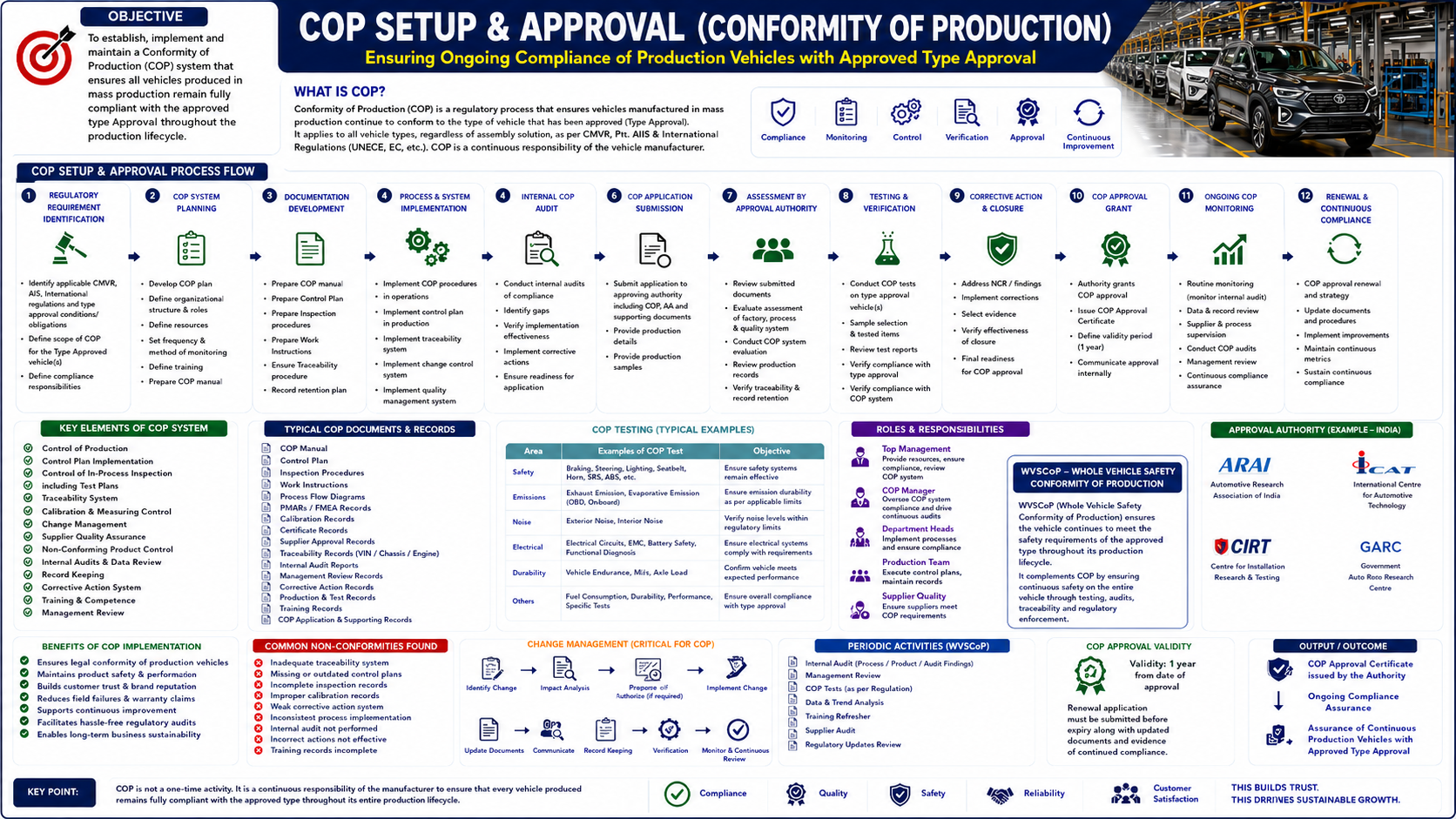
COP Setup & Approval in Automotive Product Development
Ensuring Ongoing Compliance of Production Vehicles with Approved Type Approval
COP, or Conformity of Production, is a critical regulatory and quality assurance process in automotive manufacturing. It ensures that vehicles produced during mass production continue to conform to the same approved specifications, safety requirements, emission limits, quality controls and regulatory standards that were verified during Type Approval.
After a vehicle receives Type Approval and enters production, the manufacturer must ensure that every production vehicle remains compliant with the approved vehicle type. COP is therefore not a one-time activity. It is a continuous responsibility throughout the production lifecycle.
In simple words, COP answers the question:
“Are all vehicles produced in mass production still matching the approved Type Approval specification?”
1. Objective of COP Setup & Approval
The main objective of COP is to establish, implement and maintain a system that ensures all production vehicles remain compliant with the approved Type Approval.
COP setup ensures:
Production vehicles match the approved type.
Regulatory requirements are continuously fulfilled.
Safety and emission performance are maintained.
Production processes are controlled.
Non-conforming products are identified and corrected.
Records are maintained for audits and regulatory review.
Customer safety, product quality and brand trust are protected.
The output of this phase is a COP Approval Certificate issued by the approval authority, supported by ongoing compliance assurance and continuous conformity of production vehicles.
2. What is COP?
Conformity of Production (COP) is a regulatory process that ensures vehicles manufactured in mass production continue to conform to the vehicle type that has already been granted Type Approval.
COP applies to:
- Motorcycles
- Scooters
- Passenger cars
- Commercial vehicles
- Electric vehicles
- Agricultural tractors
- Construction equipment vehicles
- Engines
- Components and systems, where applicable
COP is generally required under applicable national and international regulations such as:
- CMVR
- AIS
- UNECE / ECE regulations
- Other country-specific vehicle regulations
COP confirms that the manufacturer has an effective production control system to maintain compliance after Type Approval.
3. Why COP is Important
Type Approval confirms that the tested vehicle meets regulatory requirements. However, once production starts, thousands of vehicles may be manufactured over time. COP ensures that every vehicle produced continues to match the approved specification.
Without proper COP control, the following risks may occur:
Production vehicles may differ from approved Type Approval specifications.
Safety or emission compliance may be affected.
Regulatory audit observations may arise.
COP approval may be delayed or suspended.
Market supply may be affected.
Recall or corrective action may be required.
Customer safety and brand reputation may be impacted.
Therefore, COP is essential for maintaining legal compliance and production consistency.
4. COP Setup & Approval Process Flow
The updated image shows a structured 12-step COP Setup & Approval process.
Step 1: Regulatory Requirement Identification
The first step is to identify all applicable COP-related regulatory requirements.
Key Activities
Identify applicable CMVR, AIS and international regulations.
Understand COP approval conditions.
Define scope of COP.
Review the approved Type Approval certificate.
Identify vehicle models, variants and families covered.
Define compliance responsibilities.
Confirm applicable testing requirements.
Identify production conformity obligations.
Purpose
This step ensures that the manufacturer clearly understands what needs to be controlled and demonstrated during COP approval.
Step 2: COP System Planning
Once requirements are identified, a COP system must be planned.
Key Activities
Develop COP plan.
Define organizational structure and roles.
Define resources.
Set COP objectives and targets.
Define monitoring methods.
Define frequency of audits and testing.
Prepare COP manual.
Establish reporting system.
Important Point
COP should not be handled only by the homologation department. It requires strong involvement from production, quality, supplier quality, manufacturing engineering, testing, maintenance and management.
Step 3: Documentation Development
COP approval depends heavily on proper documentation.
Key Activities
Prepare COP manual.
Prepare Control Plan.
Prepare inspection procedures.
Prepare work instructions.
Prepare process flow diagrams.
Prepare traceability procedures.
Prepare record retention plan.
Prepare audit formats.
Prepare test plans.
Purpose
Documentation provides evidence that the production system is controlled and capable of maintaining conformity with the approved vehicle type.
Step 4: Process & System Implementation
After planning and documentation, the COP system must be implemented on the shop floor.
Key Activities
Implement COP procedures.
Train personnel.
Implement control plans.
Implement traceability system.
Implement change control system.
Implement quality management system.
Implement inspection and testing process.
Ensure production records are maintained.
Example
If a motorcycle has an approved brake hose routing during Type Approval, production must ensure the same routing is followed in mass production. Any change in routing, supplier, hose length or material must be reviewed for homologation and COP impact.
Step 5: Internal COP Audit
Before submitting COP application, the manufacturer should conduct an internal audit.
Key Activities
Conduct internal compliance audit.
Check document adequacy.
Identify implementation gaps.
Verify process effectiveness.
Review production records.
Raise corrective actions.
Ensure readiness for external assessment.
Purpose
Internal audit helps identify gaps before the approval authority reviews the COP system.
Step 6: COP Application Submission
The manufacturer submits the COP application to the designated approval authority.
Key Activities
Submit application to approval authority.
Provide supporting documents.
Provide organizational details.
Provide production sample details.
Provide production process details.
Submit COP manual and control plan.
Submit inspection and test records, if required.
In India, approval authorities and test agencies may include ARAI, ICAT, CIRT and GARC, depending on the vehicle category, testing scope and regulatory requirement.
Step 7: Assessment by Approval Authority
The approval authority reviews the submitted documents and evaluates the manufacturer’s COP system.
Key Activities
Review submitted documents.
Evaluate production facility.
Assess factory processes.
Evaluate COP system effectiveness.
Review production controls.
Verify traceability and change control.
Review quality records.
Check record retention system.
Common Review Areas
- Production process control
- Control plan implementation
- Testing plan
- Internal audit process
- Non-conforming product control
- Traceability system
- Corrective action system
- Change management process
Step 8: Testing & Verification
COP approval may require production sample testing and verification.
Key Activities
Conduct COP tests as per regulation.
Verify vehicle conformity.
Select samples for testing.
Review test reports.
Verify compliance with Type Approval.
Verify compliance with COP system.
Typical COP Test Areas
Step 9: Corrective Action & Closure
If any non-conformity or observation is found, corrective action must be taken.
Key Activities
Address non-conformities and findings.
Implement corrective actions.
Select evidence for closure.
Verify effectiveness.
Submit closure evidence.
Confirm final readiness for COP approval.
Important Point
Corrective action is not complete unless evidence is available. The manufacturer must prove that the problem has been corrected and recurrence is prevented.
Step 10: COP Approval Grant
After satisfactory review and verification, the authority grants COP approval.
Key Activities
Authority grants COP approval.
COP Approval Certificate is issued.
Validity period is defined.
Reporting frequency is defined.
Approval is communicated internally.
Records are stored in controlled system.
COP Annual Frequency / Renewal Readiness
COP activities are generally managed through annual frequency / renewal readiness for applicable vehicle and engine COP activities. Exact COP requirements, validity, testing frequency and renewal conditions must be verified vehicle-category-wise and regulation-wise.
Renewal or periodic submissions should be planned in advance with updated documents, records and compliance evidence wherever required.
Step 11: Ongoing COP Monitoring
COP continues after approval.
Key Activities
Routine monitoring.
Periodic internal audits.
Data and record review.
Supplier and process supervision.
Conduct COP audits.
Conduct COP test scheduling.
Management review.
Continuous compliance assurance.
Purpose
Ongoing monitoring ensures production vehicles remain compliant throughout the production lifecycle.
Step 12: Renewal & Continuous Compliance
COP approval must be renewed and continuously maintained.
Key Activities
COP approval renewal and strategy.
Update documents and procedures.
Implement improvements.
Maintain compliance metrics.
Sustain continuous improvement.
Review regulatory updates.
Maintain production records.
Submit renewal application before expiry.
COP renewal is necessary to continue demonstrating conformity with the approved type.
5. Key Elements of a COP System
A strong COP system includes the following elements:
- Control of production
- Control Plan implementation
- Incoming and in-process inspection, including test plans
- End-of-line testing
- Traceability system
- Calibration and measuring control
- Change management
- Supplier quality assurance
- Non-conforming product control
- Internal audits and review
- Record keeping
- Corrective action system
- Training and competence
- Management review
These elements ensure that production vehicles remain consistent, traceable, controlled and compliant.
6. Typical COP Documents and Records
The image highlights the following typical COP documents:
- COP Manual
- Control Plan
- Inspection Procedures
- Work Instructions
- Process Flow Diagrams
- PMAP / FMEA records
- Calibration Records
- Training Records
- Supplier Approval Records
- Traceability Records
- Internal Audit Reports
- Management Review Records
- Corrective Action Records
- Production and Test Records
- COP Test Reports
- Regulatory Compliance Records
These documents provide objective evidence during COP audit and renewal.
7. WVSCoP – Whole Vehicle Safety Conformity of Production
WVSCoP stands for Whole Vehicle Safety Conformity of Production.
WVSCoP ensures that every production vehicle continues to meet the safety requirements of the approved vehicle type throughout its production lifecycle.
Purpose of WVSCoP
WVSCoP focuses on safety-related conformity of the complete vehicle, not only individual components.
It may include verification of:
- Braking system
- Lighting and signalling
- Steering system
- Tyres and wheels
- Seat belts and occupant protection systems
- Horn and warning devices
- External projections
- Rear-view mirrors
- Vehicle dimensions and masses
- Safety labels and markings
- Other applicable safety-related systems
Importance of WVSCoP
WVSCoP complements COP by ensuring consistency across the complete vehicle series through:
- Testing
- Audits
- Traceability
- Regulatory oversight
- Periodic monitoring
- Corrective action
- Continuous improvement
For OEMs, WVSCoP is especially important because even small production changes can affect vehicle safety conformity.
8. Roles and Responsibilities
COP requires clear ownership across the organization.
9. Approval Authority – Example: India
For India, COP approval and related testing may involve approved agencies such as:
ARAI – Automotive Research Association of India
ICAT – International Centre for Automotive Technology
CIRT – Centre for Incubation Research & Testing / Central Institute of Road Transport, depending on applicable context
GARC – Global Automotive Research Centre
The exact agency depends on vehicle category, test requirement, approval scope and regulatory route.
10. Benefits of COP Implementation
A strong COP system provides several benefits:
Ensures legal conformity of production vehicles.
Maintains product safety and performance.
Builds customer trust and brand reputation.
Reduces field failures and warranty claims.
Improves process control and consistency.
Supports continuous improvement.
Facilitates hassle-free regulatory audits.
Ensures long-term business sustainability.
COP protects both the manufacturer and the customer by ensuring that every production vehicle remains compliant.
11. Common Non-Conformities Found During COP
The image highlights common non-conformities normally found during COP audits or reviews.
Typical issues include:
- Inadequate traceability system
- Missing or outdated control plans
- Incomplete inspection records
- Weak change management
- Improper calibration records
- Inconsistent process implementation
- Poor record retention
- Internal audit not performed
- Corrective actions not effective
- Training records incomplete
These issues can weaken the COP system and may affect approval renewal.
12. Change Management – Critical for COP
Change management is one of the most critical parts of COP.
Any change in product, process, supplier, material, software, calibration, tooling or production location must be reviewed for regulatory and conformity impact.
Change Management Flow
Identify change.
Conduct impact analysis on Type Approval.
Assess whether authority approval is required.
Implement change with control.
Update documents.
Communicate change.
Maintain records.
Verify effectiveness.
Monitor through continuous review.
Examples of Changes Requiring COP Review
- Change in brake component supplier
- Change in tyre specification
- Change in lighting device or marking
- Change in ECU software or calibration
- Change in emission-related component
- Change in battery pack or BMS software
- Change in manufacturing location
- Change in production process
- Change in material grade
- Change in safety-critical fastener
Uncontrolled changes are one of the biggest risks to COP compliance.
13. Periodic Activities Under COP and WVSCoP
The image shows periodic activities that should be performed regularly.
Periodic Activities
- Internal audit of process, product and audit findings
- Management review
- COP tests as per regulation
- Data and trend analysis
- Training refresher
- Supplier audit
- Regulatory update review
- Calibration verification
- Corrective action review
- Record retention review
These activities help sustain COP and WVSCoP compliance throughout the production lifecycle.
14. COP Annual Frequency and Renewal Readiness
COP Annual Frequency / Renewal Readiness: generally managed on an annual cycle where applicable; confirm exact requirement from applicable regulation and approval authority.
Where renewal or periodic submission applies, the manufacturer should prepare updated documents and evidence of continued compliance before the applicable due date.
Renewal Preparation Should Include
- Updated COP manual
- Updated Control Plan
- Production and inspection records
- COP test reports
- Internal audit reports
- Management review records
- Corrective action records
- Supplier audit records
- Calibration records
- Regulatory compliance records
- Change management records
Timely renewal avoids compliance gaps and production disruption.
15. Outputs and Outcomes
The key outputs of COP Setup and Approval are:
- COP Approval Certificate issued by the authority
- Ongoing compliance assurance
- Assurance of continuous conformity of production vehicles with approved Type Approval
- Improved production control
- Strong traceability
- Better audit readiness
- Reduced regulatory and warranty risk
The outcome is a controlled production system that continues to deliver compliant vehicles.
16. Practical Example: Motorcycle COP
For motorcycles, COP control may include:
- Emission conformity
- Noise conformity
- Brake performance
- ABS function
- Lighting and signalling
- Horn performance
- Tyre specification
- Rear-view mirror conformity
- Vehicle identification and labels
- Component approval marking
- Safety-critical torque controls
- Production traceability
Typical COP risks in motorcycles include lamp marking mismatch, tyre specification mismatch, brake hose routing changes, emission calibration variation and incorrect component revision.
17. Practical Example: Passenger Car COP
For passenger cars, COP control may include:
- Emission conformity
- OBD conformity
- Braking and ESC performance
- Lighting conformity
- Passive safety-related parts
- Seat belt and airbag system control
- EMC-related systems
- Tyre and wheel specification
- VIN and statutory plates
- Production traceability
- Change control
Passenger car COP requires strong control of complete vehicle configuration, software versions, supplier changes and safety systems.
18. Practical Example: EV COP
For electric vehicles, COP control may include:
- Battery pack traceability
- BMS software version control
- High-voltage safety
- Insulation resistance
- Charging system conformity
- EMC compliance
- Motor and controller specification
- Thermal management system
- Warning labels
- EV safety checks
- COP testing and documentation
EV COP requires special attention because changes in battery, software, charger, motor controller or thermal system can affect safety and regulatory compliance.
19. Key Risks in COP Setup & Approval
Typical risks include:
- COP planning delay
- Incomplete documentation
- Weak traceability system
- Uncontrolled production changes
- Supplier certificate mismatch
- Missing calibration records
- Incomplete test records
- Audit non-conformities
- Poor corrective action closure
- COP renewal delay
- Non-conforming production vehicles
- Regulatory update not considered
- Inadequate management review
These risks must be tracked through a COP compliance tracker.
20. Best Practices for COP Setup & Approval
To achieve effective COP approval:
Start COP planning during industrialization stage.
Link COP plan with Type Approval specification.
Maintain strong production traceability.
Keep Control Plan updated.
Ensure regular internal audits.
Verify supplier conformity records.
Maintain calibration records.
Conduct periodic COP testing.
Review changes before implementation.
Train production, quality and supplier teams.
Maintain proper record retention.
Conduct management review regularly.
Submit renewal application before expiry.
Track all non-conformities until closure.
Include WVSCoP requirements in periodic review.
Conclusion
COP Setup and Approval is a critical phase that ensures production vehicles remain compliant with the approved Type Approval throughout the production lifecycle. It connects regulatory compliance, manufacturing control, quality assurance, supplier management, testing, traceability and continuous improvement.
With COP activities generally managed through annual frequency or renewal readiness where applicable, manufacturers must maintain active monitoring, periodic audits, controlled documentation, COP testing and timely submissions. Exact requirements must be verified vehicle-category-wise and regulation-wise.
WVSCoP - Whole Vehicle Safety Conformity of Production further strengthens the process by confirming that production vehicles continue to meet approved whole-vehicle safety requirements.
The final output of this phase is:
A COP Approval Certificate issued by the authority and continuous assurance that production vehicles conform to the approved Type Approval.
Key Takeaways
COP ensures production vehicles continue to match approved Type Approval.
COP is a continuous responsibility, not a one-time approval.
COP frequency, validity, testing and renewal conditions should be controlled according to the applicable regulation, vehicle category and approval authority.
WVSCoP means Whole Vehicle Safety Conformity of Production.
Key COP controls include documentation, process control, testing, traceability, audits, supplier quality and change management.
Strong COP implementation supports legal compliance, customer safety, product quality and business sustainability.
Reference tables from the source chapter
| Area | Examples of COP Tests | Objective |
|---|---|---|
| Safety | Braking, steering, lighting, seat belt, horn, SRS, ABS, ESC | Ensure safety systems remain effective |
| Emissions | Exhaust emission, evaporative emission, OBD, durability | Ensure vehicles comply with emission standards |
| Noise | Exterior noise, interior noise | Verify noise remains within limits |
| Electrical | Electrical circuits, EMC, battery safety, diagnostics | Ensure electrical systems comply |
| Dimensions | Vehicle dimensions, mass, axle load | Confirm vehicle meets approved specification |
| Others | Fuel consumption, durability, performance, special tests | Ensure overall compliance |
Reference table 2
| Role | Responsibility |
|---|---|
| Top Management | Provide resources, review compliance and support COP performance |
| COP Manager | Manage COP system, coordination, audits and regulatory interaction |
| Quality Team | Conduct inspection, testing, audits and record management |
| Production Team | Follow standard process, control production and maintain traceability |
| Supplier Quality | Ensure supplier parts meet approved specifications |
| Homologation / Regulatory Team | Monitor regulatory requirements and approval conditions |
| Manufacturing Engineering | Maintain process capability and update process controls |
| Testing Team | Conduct COP-related testing and prepare test reports |
| Maintenance Team | Maintain equipment reliability and calibration support |
Frequently asked questions
What is Conformity of Production?
COP is the regulatory system that demonstrates vehicles produced in series continue to conform to the approved vehicle type.
What is WVSCoP?
Whole Vehicle Safety Conformity of Production focuses on continued conformity with approved whole-vehicle safety requirements across production, audit, testing, and change-control activities.
Is COP a one-time approval?
No. It requires continuing controls, records, audits, periodic tests, supplier oversight, corrective action, approval maintenance, and renewal where applicable.