Mass Production and Continuous Improvement
Chapter 12 · Automotive Product Development
Use the infographic for the process overview, then follow the chapter sections for definitions, activities, deliverables, gate evidence, and implementation detail.
Chapter infographic
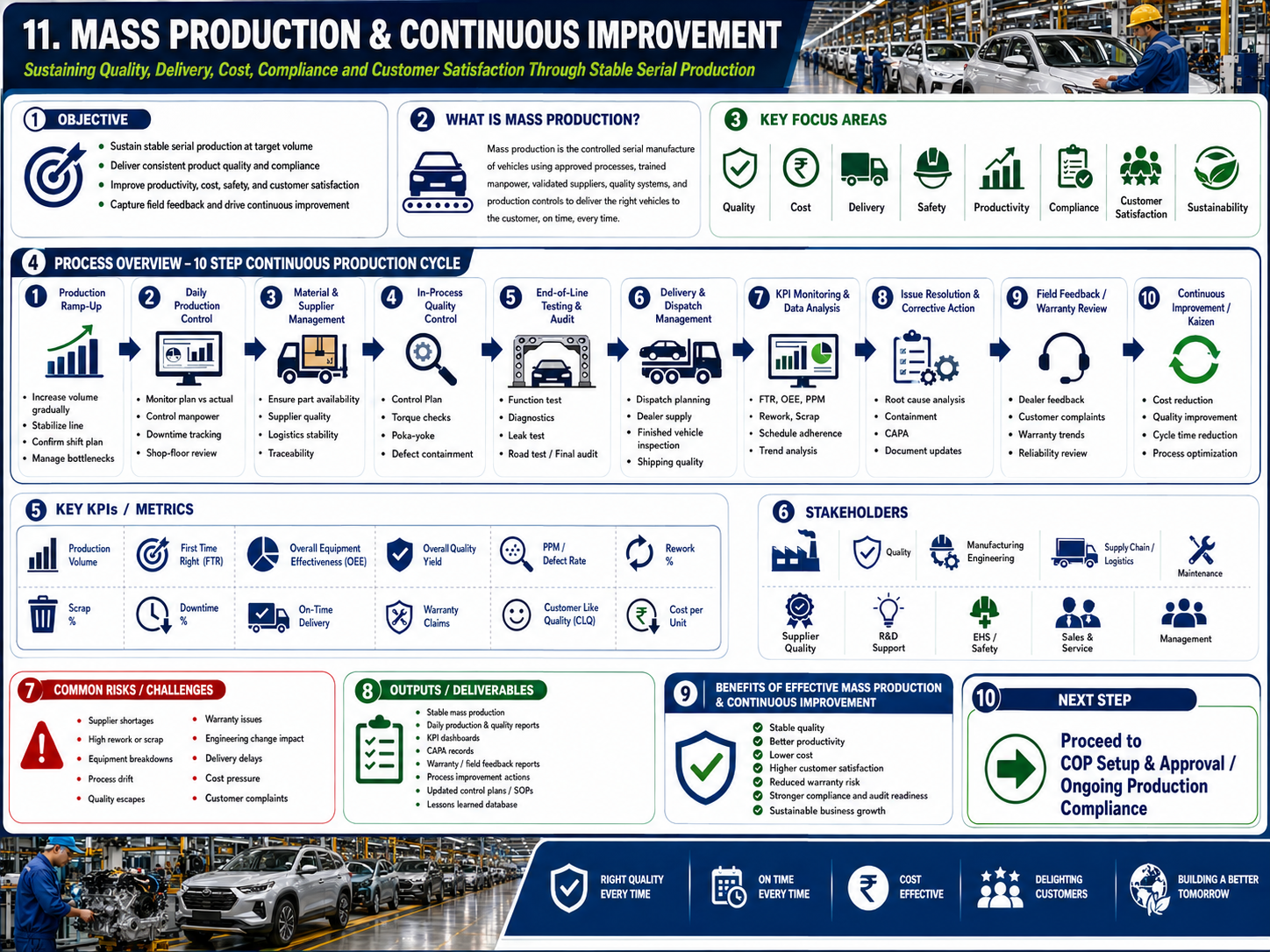
Mass Production & Continuous Improvement in Automotive Product Development
Sustaining Quality, Delivery, Cost, Compliance and Customer Satisfaction Through Stable Serial Production
Mass Production is the stage where the vehicle is manufactured continuously at the planned production volume after successful completion of SOP. At this stage, the product has already passed development, validation, homologation, industrialization, pilot build and SOP approval. The focus now shifts to producing vehicles consistently, controlling daily operations, maintaining quality, meeting delivery commitments and continuously improving cost, productivity and customer satisfaction.
Mass Production is not only about producing higher volumes. It is about producing the right quality vehicle, at the right cost, at the right time, every time.
In simple words, this phase answers the question:
“Can we manufacture approved vehicles repeatedly at target volume while maintaining quality, cost, delivery, compliance and customer satisfaction?”
1. Objective of Mass Production & Continuous Improvement
The key objectives of this phase are:
Sustain stable serial production at target volume.
Deliver consistent product quality and regulatory compliance.
Improve productivity, cost, safety and customer satisfaction.
Capture field feedback and drive continuous improvement.
Maintain supplier stability and material availability.
Reduce defects, rework, scrap and warranty issues.
Build a sustainable and efficient production system.
Mass Production is successful only when vehicles are produced consistently with stable quality, controlled cost, on-time delivery and minimum field issues.
2. What is Mass Production?
Mass Production is the controlled serial manufacturing of vehicles using:
- Approved production processes
- Trained manpower
- Validated suppliers
- Qualified tools and equipment
- Stable quality systems
- Approved work instructions
- Production controls
- End-of-line testing systems
- Traceability systems
The objective is to deliver the right vehicles to customers on time, every time.
After SOP, the production line gradually increases volume through ramp-up and then reaches stable production. During this phase, continuous monitoring is essential to identify abnormalities and take corrective action quickly.
3. Key Focus Areas During Mass Production
The image highlights eight major focus areas.
3.1 Quality
Quality is the most important focus area during mass production. Every vehicle must meet the approved product specification, customer expectation, safety requirement and regulatory requirement.
Key quality activities include:
- In-process quality checks
- End-of-line testing
- Final inspection
- Customer-like quality audits
- Defect containment
- Warranty monitoring
- Field issue analysis
The aim is to achieve right quality every time.
3.2 Cost
Cost control is essential for profitability.
Cost improvement can be achieved through:
- Scrap reduction
- Rework reduction
- Productivity improvement
- Supplier cost improvement
- Process optimization
- Energy saving
- Material waste reduction
- Standardization
- Kaizen activities
Cost reduction should never compromise safety, quality or regulatory compliance.
3.3 Delivery
Delivery performance ensures that vehicles reach dealers and customers as per plan.
Key delivery controls include:
- Production schedule adherence
- Dispatch planning
- Finished vehicle inspection
- Logistics coordination
- Dealer supply planning
- On-time delivery tracking
Poor delivery performance can affect customer satisfaction and market confidence.
3.4 Safety
Safety includes both product safety and workplace safety.
Production teams must ensure:
- Safe working conditions
- Machine guarding
- PPE usage
- EHS compliance
- Safe handling of parts
- High-voltage safety for EVs
- Safe vehicle movement
- Emergency preparedness
A successful production system must protect both customers and employees.
3.5 Productivity
Productivity measures how efficiently the production system converts input into output.
Productivity improvement includes:
- Cycle time reduction
- Bottleneck removal
- Line balancing
- OEE improvement
- Downtime reduction
- Manpower optimization
- Automation improvement
- Standard work improvement
Higher productivity supports better cost control and faster delivery.
3.6 Compliance
Compliance means production vehicles must continue to meet approved specifications and regulatory requirements.
Compliance includes:
- Approved part usage
- Homologation specification control
- COP readiness
- Label compliance
- Emission / safety compliance
- Change control
- Traceability records
- Audit readiness
Any production change must be reviewed for homologation, quality and customer impact.
3.7 Customer Satisfaction
Customer satisfaction is the final measure of production success.
It is influenced by:
- Product quality
- Delivery experience
- Reliability
- Fit and finish
- Performance
- Serviceability
- Low warranty issues
- Dealer feedback
Field feedback must be continuously reviewed and converted into corrective and preventive actions.
3.8 Sustainability
Modern automotive production must also focus on sustainability.
This includes:
- Energy efficiency
- Waste reduction
- Water conservation
- Material optimization
- Recycling
- Lower emissions from production
- Sustainable packaging
- Environmental compliance
Sustainability is becoming increasingly important for OEMs, suppliers and customers.
4. Process Overview – 10-Step Continuous Production Cycle
The image shows a 10-step continuous production cycle.
Step 1: Production Ramp-Up
After SOP, production volume is increased gradually.
Key Activities
Increase volume step by step.
Stabilize production line.
Confirm shift plan.
Manage bottlenecks.
Monitor early production quality.
Track supplier supply capability.
Confirm manpower readiness.
Purpose
Ramp-up helps the production system move safely from low volume to target volume without quality collapse or supply disruption.
Step 2: Daily Production Control
Daily production control ensures that the plant produces vehicles as per plan.
Key Activities
Monitor plan vs actual production.
Control manpower allocation.
Track downtime.
Conduct shop-floor reviews.
Monitor shift output.
Review production losses.
Track critical shortages.
Take immediate action on deviations.
Daily production meetings are very important during this stage.
Step 3: Material & Supplier Management
Mass production depends heavily on stable supplier performance.
Key Activities
Ensure part availability.
Monitor supplier quality.
Maintain logistics stability.
Maintain part traceability.
Track supplier delivery performance.
Manage inventory levels.
Control engineering revision levels.
Review shortage risks.
Common Supplier Issues
- Delivery delay
- Wrong part supply
- Quality rejection
- Packaging damage
- Old revision part supply
- Capacity limitation
- Transportation delay
Strong supplier control prevents line stoppage and quality problems.
Step 4: In-Process Quality Control
In-process quality control prevents defects from moving to the next stage.
Key Activities
Follow Control Plan.
Conduct torque checks.
Use poka-yoke systems.
Monitor critical process parameters.
Detect abnormalities.
Stop defects at source.
Apply containment where needed.
Update quality records.
Examples include torque verification, leak check, electrical connection check, visual inspection, fixture check and process parameter monitoring.
Step 5: End-of-Line Testing & Audit
End-of-line testing confirms that the finished vehicle is functionally ready before dispatch.
Key Activities
- Function testing
- Diagnostics check
- Leak testing
- Road test / final audit
- Electrical system check
- Safety feature verification
- Data capture
- Traceability confirmation
EOL testing is a critical quality gate before customer delivery.
Step 6: Delivery & Dispatch Management
After quality approval, vehicles are dispatched to dealers or customers.
Key Activities
- Dispatch planning
- Dealer supply coordination
- Finished vehicle inspection
- Shipping quality check
- Documentation preparation
- Transport coordination
- Delivery tracking
Dispatch quality is important because damage during storage, handling or transportation can affect customer satisfaction.
Step 7: KPI Monitoring & Data Analysis
Mass production must be controlled using measurable data.
Key Activities
Monitor FTR, OEE and PPM.
Track rework and scrap.
Monitor schedule adherence.
Conduct trend analysis.
Review line efficiency.
Monitor downtime.
Track warranty claims.
Review customer feedback.
Data helps identify whether the production system is improving or becoming unstable.
Step 8: Issue Resolution & Corrective Action
Issues found during production or from the field must be resolved systematically.
Key Activities
- Root cause analysis
- Containment
- Corrective and preventive action
- CAPA implementation
- Verification of effectiveness
- Document update
- Training update
- Recurrence prevention
A strong corrective action process reduces repeated defects and warranty failures.
Step 9: Field Feedback / Warranty Review
Field feedback is a valuable input for continuous improvement.
Key Activities
Review dealer feedback.
Analyse customer complaints.
Monitor warranty trends.
Conduct reliability review.
Identify repeat concerns.
Feed issues back to design, quality and production teams.
Field feedback helps manufacturers improve both current production and future product development.
Step 10: Continuous Improvement / Kaizen
Continuous Improvement ensures that production keeps becoming better over time.
Key Activities
- Cost reduction
- Quality improvement
- Cycle time reduction
- Process optimization
- Waste reduction
- Productivity improvement
- Ergonomic improvement
- Safety improvement
- Supplier improvement
Kaizen should be a continuous culture, not a one-time activity.
5. Key KPIs / Metrics
The image highlights important KPIs used during mass production.
These KPIs should be reviewed regularly by production, quality, supply chain and management teams.
6. Stakeholders Involved
Mass Production and Continuous Improvement require strong cross-functional coordination.
Production
Responsible for daily vehicle manufacturing, manpower utilization, shift output and standard work execution.
Quality
Responsible for inspection, defect control, quality gates, customer-like quality and issue closure.
Manufacturing Engineering
Responsible for process stability, tooling improvement, layout optimization and productivity improvement.
Supply Chain / Logistics
Responsible for material supply, inventory, line-side feeding, dispatch and logistics coordination.
Maintenance
Responsible for equipment uptime, breakdown response, preventive maintenance and spare readiness.
Supplier Quality
Responsible for supplier defect control, supplier audits, corrective actions and PPAP / process stability.
R&D Support
Responsible for design-related issue resolution, engineering change support and technical investigation.
EHS / Safety
Responsible for workplace safety, environmental compliance, PPE, safety audits and incident prevention.
Sales & Service
Responsible for dealer feedback, customer feedback, warranty information and field issue reporting.
Management
Responsible for performance review, resource support, decision-making and escalation closure.
7. Common Risks and Challenges
The image highlights several common risks.
Supplier Shortages
Part shortages can stop production and delay customer delivery.
High Rework or Scrap
High rework or scrap indicates poor process control, supplier issues or design/process mismatch.
Equipment Breakdowns
Machine breakdowns reduce productivity and affect delivery.
Process Drift
Process drift happens when production parameters gradually move away from standard conditions.
Quality Escapes
Quality escape means a defect reaches the customer or dealer despite internal controls.
Warranty Issues
Warranty problems indicate field reliability concerns and must be analysed quickly.
Engineering Change Impact
Uncontrolled engineering changes can create part mismatch, documentation errors and quality issues.
Delivery Delays
Poor scheduling, supplier delay or logistics problems can affect dealer and customer satisfaction.
Cost Pressure
Cost reduction pressure must be balanced with safety, quality and compliance.
Customer Complaints
Customer complaints must be treated as important feedback for corrective and preventive action.
8. Outputs and Deliverables
The key outputs of Mass Production and Continuous Improvement are:
- Stable mass production
- Daily production reports
- Quality reports
- KPI dashboards
- CAPA records
- Warranty and field feedback reports
- Process improvement actions
- Updated control plans and SOPs
- Lessons learned database
- Supplier performance records
- Audit reports
- Customer satisfaction reports
These outputs support production control, management review, regulatory compliance, COP and future product development.
9. Benefits of Effective Mass Production & Continuous Improvement
Effective mass production provides the following benefits:
10. Link with COP Setup & Approval
The image shows the next step as:
Proceed to COP Setup & Approval / Ongoing Production Compliance
This is important because once vehicles are produced in mass production, the manufacturer must ensure that production vehicles continue to match the approved Type Approval specification.
Mass Production and COP are closely connected through:
- Production traceability
- Approved component control
- Process control
- Quality records
- Audit readiness
- Regulatory compliance
- Change control
- Periodic testing
- Corrective actions
Therefore, a strong mass production system directly supports COP approval and ongoing production compliance.
11. Practical Example: Motorcycle Mass Production
For motorcycle production, key mass production controls may include:
- Frame and engine number traceability
- Engine fitment process
- Brake hose routing control
- ABS modulator connection check
- Torque control for safety fasteners
- Wiring harness routing and clipping
- Fuel tank leak check
- Headlamp and indicator function check
- Chain alignment
- Wheel alignment
- EOL electrical check
- Road test and final inspection
- Dealer feedback monitoring
- Warranty issue tracking
Common motorcycle production issues include missing clips, loose fasteners, wiring fouling, brake hose routing errors, battery issues, fuel leakage, noise complaints and cosmetic defects.
12. Practical Example: Passenger Car Mass Production
For passenger car production, mass production controls may include:
- Body shop dimensional control
- Paint quality monitoring
- Door gap and flushness check
- Interior fitment quality
- Wiring harness routing
- Brake fluid filling and bleeding
- Coolant filling
- Wheel alignment
- EOL diagnostics
- Water leak test
- Road test
- Final audit
- Dispatch quality check
- Customer-like quality audit
Passenger cars require strong attention to fit and finish, noise, water leakage, electrical functions, software configuration and customer-facing quality.
13. Practical Example: EV Mass Production
For EV production, additional controls are required for:
- Battery pack traceability
- High-voltage cable routing
- HV connector locking
- Insulation resistance testing
- BMS software verification
- Charger function test
- Motor controller diagnostics
- Thermal management filling
- Fire safety readiness
- EV-specific EOL testing
- Charging test
- Battery label verification
- Warranty and field range monitoring
EV mass production needs strong control over high-voltage safety, battery systems, software, diagnostics and thermal management.
14. Corrective Action and CAPA System
A strong CAPA system is essential during mass production.
CAPA Flow
Identify the issue.
Contain the affected vehicles or parts.
Log the issue in the tracker.
Analyse root cause.
Define corrective action.
Implement corrective action.
Verify effectiveness.
Update documents and standards.
Train operators if required.
Prevent recurrence.
Documents Updated After CAPA
- Work instructions
- Control plan
- PFMEA
- Inspection standards
- Training records
- Supplier quality documents
- Maintenance standards
- Design documents, if applicable
15. Best Practices for Mass Production
To achieve stable mass production:
Maintain strict standard work discipline.
Monitor daily KPIs.
Conduct daily shop-floor reviews.
Use visual management.
Strengthen in-process quality control.
Monitor supplier quality and delivery.
Maintain equipment through preventive maintenance.
Use poka-yoke for critical processes.
Capture all defects and conduct root cause analysis.
Review warranty and field feedback regularly.
Control engineering changes strictly.
Update SOPs and control plans after improvements.
Build a strong Kaizen culture.
Keep customer satisfaction as the final measure of success.
16. Mass Production Maturity Levels
Mass production generally improves in stages:
Stage 1: Early Mass Production
Focus:
- Stabilize output
- Reduce launch defects
- Monitor EOL failures
- Control supplier issues
- Review customer feedback
Stage 2: Stable Production
Focus:
- Achieve target volume
- Improve line efficiency
- Reduce rework and scrap
- Strengthen quality consistency
- Improve delivery performance
Stage 3: Optimized Production
Focus:
- Cost reduction
- Productivity improvement
- Process automation
- Waste reduction
- Continuous improvement
- Customer delight
Conclusion
Mass Production and Continuous Improvement is the phase where the vehicle is manufactured consistently at target volume while maintaining quality, cost, delivery, safety, compliance and customer satisfaction.
A strong mass production system ensures stable output, fewer defects, lower warranty risk, better productivity and sustainable business growth. Continuous improvement through Kaizen, CAPA, field feedback and KPI monitoring helps the organization improve quality and efficiency throughout the product lifecycle.
The final output of this phase is:
Stable serial production with consistent quality, on-time delivery, cost-effective operations, customer satisfaction and strong readiness for COP setup and ongoing production compliance.
Key Takeaways
Mass Production begins after SOP and production ramp-up.
Key focus areas are quality, cost, delivery, safety, productivity, compliance, customer satisfaction and sustainability.
Daily production control, supplier management, in-process quality, EOL testing and KPI monitoring are essential.
Field feedback and warranty review must drive continuous improvement.
CAPA and Kaizen are core methods for reducing defects and improving productivity.
The next step is COP Setup & Approval / Ongoing Production Compliance.
Reference tables from the source chapter
| KPI / Metric | Purpose |
|---|---|
| Production Volume | Tracks daily, weekly and monthly production output |
| First Time Right (FTR) | Measures how many vehicles are built correctly without rework |
| Overall Equipment Effectiveness (OEE) | Measures equipment availability, performance and quality |
| Overall Quality Yield | Measures percentage of acceptable production output |
| PPM / Defect Rate | Tracks number of defects per million parts or opportunities |
| Rework % | Measures vehicles or parts requiring correction |
| Scrap % | Measures rejected materials or parts |
| Downtime % | Tracks production stoppage and equipment loss |
| On-Time Delivery | Measures delivery performance against plan |
| Warranty Claims | Tracks customer field issues after sale |
| Customer Like Quality (CLQ) | Measures customer-facing quality |
| Cost Per Unit | Monitors manufacturing cost efficiency |
Reference table 2
| Benefit | Explanation |
|---|---|
| Stable Quality | Consistent product quality during serial production |
| Better Productivity | Higher output with better process efficiency |
| Lower Cost | Reduced scrap, rework, downtime and waste |
| Higher Customer Satisfaction | Fewer complaints and better ownership experience |
| Reduced Warranty Risk | Lower field failures and improved reliability |
| Stronger Compliance and Audit Readiness | Better traceability, process control and documentation |
| Sustainable Business Growth | Stable operations and continuous improvement culture |
Frequently asked questions
What changes after SOP moves into mass production?
The emphasis shifts from launch readiness to stable volume, consistent quality, delivery performance, cost control, compliance, maintenance, and systematic improvement.
How are production problems prevented from recurring?
Teams contain the issue, find root cause, implement and verify corrective action, update standards and controls, and monitor effectiveness over time.
How does field data improve production?
Warranty, dealer, service, telematics, and complaint trends can reveal process escapes or design weaknesses that require plant, supplier, or engineering action.