Software-Defined Vehicle (SDV): Architecture, Technology Stack, Development, Validation & Homologation
Engineering Deep Dives · AutoPDP
Software-centric vehicle architecture, zonal computing, vehicle OS, APIs, OTA, cloud and lifecycle software evolution.
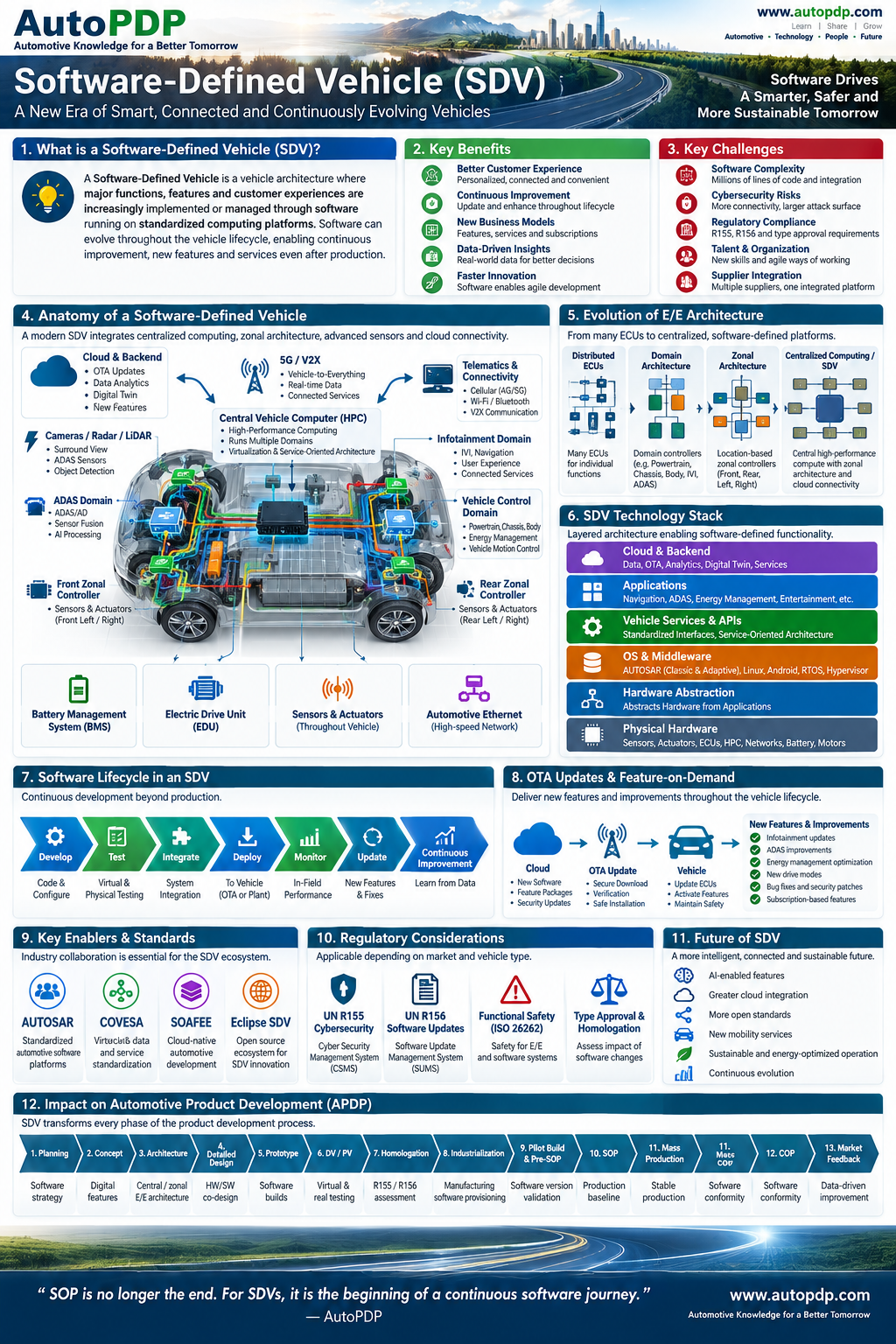
What this article covers
- E/E architecture and compute consolidation
- Vehicle software platforms, APIs and OTA delivery
- Cybersecurity, validation, homologation and lifecycle change control
Architecture, Technology Stack, Development, Validation & Homologation
AutoPDP Engineering Deep Dive
Suggested reading time: 20-25 minutes
In one sentence: A Software-Defined Vehicle is a vehicle architecture in which an increasing share of vehicle functions, features and customer experiences are implemented, controlled, updated or improved through software running on standardized computing platforms.
Why SDV Matters
SOP is no longer the end. For SDVs, it is the beginning of a continuous software journey.
The automotive industry is moving from vehicles dominated by mechanical systems and many independent electronic control units toward vehicles built around high-performance computing, standardized software platforms, vehicle services, connectivity and continuous software evolution.
This does not mean that hardware becomes unimportant. Brakes, steering, sensors, actuators, batteries, motors, chassis and vehicle structures remain fundamental. The change is that more of the value delivered by those systems is coordinated and differentiated through software.
A useful way to understand the transition is:
Traditional vehicle: Hardware largely determines what the vehicle can do.
Software-Defined Vehicle: Hardware provides the platform, while software increasingly determines how the vehicle behaves, what functions are available and how those functions can evolve throughout the lifecycle.
AUTOSAR describes the SDV ecosystem as extending automotive software beyond onboard software to interaction between in-vehicle and offboard systems. It also identifies hardware/software decoupling and a vehicle software platform as important enablers of continuous software innovation. Eclipse SDV similarly focuses on scalable, modular and extensible open software platforms for in-vehicle and around-vehicle applications.
1. What Is a Software-Defined Vehicle?
There is no single globally binding legal definition of an SDV. In industry practice, the term generally refers to a vehicle in which software has become a primary mechanism for implementing and evolving functions across the vehicle lifecycle.
An SDV typically combines:
- High-performance vehicle computers (HPCs)
- Domain and/or zonal E/E architecture
- Standardized operating environments and middleware
- Service-oriented architecture
- Vehicle APIs
- Connectivity between vehicle and cloud
- Over-the-air (OTA) software updates
- Cybersecurity controls
- Continuous integration and validation
- Data analytics and remote diagnostics
- Software configuration and version management
The key concept is decoupling. Vehicle applications should depend less on one specific piece of hardware and more on standardized services and interfaces.
SDV is not simply “a car with a lot of software”
Modern vehicles have contained software for decades. An SDV goes further by introducing architectural and lifecycle changes that make software reusable, updateable, modular and more independent from individual ECUs.
Likewise, OTA capability alone does not make a vehicle an SDV. OTA is one important capability within a broader architecture involving compute consolidation, software platforms, APIs, security, cloud connectivity, configuration control and continuous development.
2. Traditional Vehicle vs Software-Defined Vehicle
| Area | Traditional Vehicle | Software-Defined Vehicle |
|---|---|---|
| E/E architecture | Many distributed ECUs | Domain, zonal and centralized compute |
| Function ownership | Often tied to ECU hardware | Increasingly software/service based |
| Hardware/software relationship | Closely coupled | Greater abstraction and portability |
| Software update | Workshop programming common | OTA increasingly supported |
| Feature introduction | Mostly fixed at launch | Features can evolve after SOP |
| Connectivity | Limited or application-specific | Vehicle-cloud integration |
| Data usage | Diagnostics focused | Continuous analytics and services |
| Testing | Vehicle-heavy physical validation | More SIL, HIL, virtualization and automation |
| Product lifecycle | Major changes at model updates | Continuous software evolution |
| Business model | Mainly vehicle sale | Vehicle + digital services possible |
The exact architecture varies by OEM and vehicle segment. Some vehicles will remain hybrid architectures for many years, with legacy ECUs coexisting with centralized compute.
3. Evolution of Automotive E/E Architecture
Connect these computing choices to Vehicle Architecture & System Design.
The move toward SDVs is strongly linked to the evolution of electrical/electronic architecture.
3.1 Distributed ECU Architecture
Traditional vehicles commonly use many ECUs, each dedicated to one or a few functions:
- Engine control
- ABS / ESC
- Airbag
- HVAC
- Instrument cluster
- Infotainment
- Body control
- Door modules
- Lighting
- ADAS
This architecture is proven, but it can create:
- Large wiring harnesses
- Multiple software baselines
- Many proprietary interfaces
- Integration complexity
- Repeated computing hardware
- Difficult cross-domain features
3.2 Domain Architecture
Domain controllers consolidate related functions into major domains such as:
- Powertrain
- Chassis
- Body
- Infotainment
- ADAS
- Connectivity
This reduces some ECU fragmentation but still creates functional silos.
3.3 Zonal Architecture
Zonal architecture organizes vehicle electronics partly by physical location.
Typical zones might include:
- Front-left
- Front-right
- Rear-left
- Rear-right
Sensors and actuators connect to nearby zonal controllers, while central computing platforms execute higher-level functions. This can reduce harness complexity and support centralized processing.
3.4 Centralized High-Performance Computing
Advanced SDV architectures use one or more high-performance computers to execute functions that were historically distributed across many ECUs.
Possible workloads include:
- ADAS / automated driving
- Vehicle motion control
- Energy management
- Infotainment
- Connectivity
- Diagnostics
- Data processing
- Digital services
The transition is evolutionary rather than instantaneous. Safety-critical embedded controllers may continue to coexist with centralized compute for many vehicle generations.
4. Anatomy of an SDV
A simplified SDV architecture can be viewed as:
                    CLOUD & BACKEND
        OTA | Analytics | Digital Twin | Services
                           |
                     Connectivity
                      5G / V2X
                           |
                CENTRAL VEHICLE COMPUTER
                    High-Performance Compute
                           |
         -----------------------------------------
         |                |              |         |
       ADAS          Vehicle Control   IVI      Apps
         |                |              |         |
         -----------------------------------------
                           |
                  Vehicle Services / APIs
                           |
                    Automotive Ethernet
                           |
        ---------------------------------------------
        |              |              |             |
     Front Zone     Rear Zone      Left Zone     Right Zone
        |              |              |             |
                Sensors & Actuators
Key physical and digital elements can include:
- Cameras, radar and LiDAR
- Wheel-speed, pressure and temperature sensors
- Steering and braking actuators
- BMS and battery systems
- Electric drive unit and inverter
- Infotainment and HMI
- Telematics module
- Automotive Ethernet
- CAN / LIN networks where appropriate
- Central and zonal controllers
- Cloud backend and OTA infrastructure
5. The SDV Technology Stack
An SDV can be understood as a layered technology stack.
Layer 1 - Physical Hardware
Includes:
- Sensors
- Actuators
- ECUs
- Zonal controllers
- HPCs
- Networks
- Battery and electric drive systems
- Cameras, radar and LiDAR
Layer 2 - Hardware Abstraction
Hardware abstraction provides standardized software access to underlying hardware. It helps improve:
- Portability
- Reuse
- Platform migration
- Parallel hardware/software development
Layer 3 - Operating Systems & Middleware
Possible technologies include:
- AUTOSAR Classic Platform
- AUTOSAR Adaptive Platform
- RTOS
- Linux
- Android Automotive
- Hypervisors
- Communication middleware
- Diagnostics services
- Security services
A modern SDV may use several operating environments simultaneously rather than one single “Vehicle OS.”
Layer 4 - Vehicle Services & APIs
This layer exposes vehicle functions and data through standardized services.
Examples:
- Vehicle speed
- Battery state of charge
- Door status
- Climate setting
- Charging status
- Vehicle location
- Tyre pressure
- ADAS state
- Diagnostic information
AUTOSAR's Automotive API work is intended to support manufacturer- and vehicle-independent access to vehicle data and services. COVESA's Vehicle Signal Specification (VSS) provides an open, protocol-agnostic model for describing vehicle data consistently in the vehicle and cloud.
Layer 5 - Applications
Applications may implement:
- Navigation
- ADAS functions
- Charging optimization
- Energy management
- Personalized profiles
- Predictive maintenance
- Digital key
- Fleet services
- Entertainment
Layer 6 - Cloud & Backend
Cloud infrastructure can support:
- OTA software distribution
- Fleet monitoring
- Analytics
- Digital twins
- Remote diagnostics
- Cybersecurity monitoring
- Feature management
- Development and simulation
The SDV therefore extends beyond the physical vehicle into a complete vehicle-cloud software ecosystem.
6. Service-Oriented Architecture (SOA)
Service-oriented architecture is a major SDV concept.
Instead of a software application communicating directly with every underlying ECU, vehicle capabilities can be exposed as reusable services.
For example:
Navigation Application
        |
Vehicle Position Service
        |
Vehicle Middleware / API
        |
GNSS + Vehicle Sensors
Benefits include:
- Better software reuse
- Reduced point-to-point dependencies
- Easier system integration
- Greater portability
- Improved scalability
- Cleaner ownership of interfaces
SOA does not remove the need for real-time embedded control. Instead, it provides an architectural layer that helps higher-level functions use vehicle capabilities more consistently.
7. AUTOSAR and SDV
AUTOSAR remains highly relevant in SDV development.
AUTOSAR Classic Platform
Commonly used for deeply embedded, deterministic and resource-constrained control functions such as:
- Engine and powertrain control
- Body electronics
- Chassis control
- Safety-related embedded functions
AUTOSAR Adaptive Platform
Designed for higher-performance computing and dynamic, service-oriented applications. Typical areas can include:
- ADAS
- Connectivity
- High-performance vehicle computing
- Data-intensive functions
- Service-oriented applications
AUTOSAR describes Classic and Adaptive as complementary foundations in the evolution toward vehicle software platforms and SDV architectures.
Common Adaptive Platform Implementation (CAPI)
AUTOSAR's CAPI initiative moves beyond specifications toward a shared implementation foundation for Adaptive Platform functionality. In 2026 AUTOSAR described CAPI as part of its transition toward implementation-driven SDV and AI-defined vehicle deployment.
8. COVESA and Vehicle Data
Software-defined vehicles depend on consistent vehicle data.
COVESA's Vehicle Signal Specification (VSS) is an open data model for normalizing vehicle data such as speed, tyre pressure and interior states. It is designed to work both inside and outside the vehicle and is protocol- and technology-agnostic.
Why this matters:
- Different ECUs and OEMs often represent similar signals differently.
- Digital services need a consistent understanding of vehicle data.
- Common data models simplify cloud integration and application portability.
- Standardized data reduces integration effort and fragmentation.
For SDVs, data interoperability is almost as important as software interoperability.
9. Eclipse SDV and Open-Source Ecosystem
The Eclipse Software Defined Vehicle Working Group provides an open collaboration environment for software platforms and tooling needed for scalable, modular and extensible vehicle software.
The Eclipse SDV ecosystem includes projects related to areas such as:
- Middleware
- Diagnostics
- High-performance ECUs
- Development tooling
- Digital twins
- Orchestration
- Safety-related software engineering
Open-source platforms can reduce duplicated non-differentiating work while allowing OEMs and suppliers to focus on customer-specific functions.
10. Cloud-Native Development & SOAFEE
SDVs are driving automotive software development toward methods already common in cloud and enterprise software, including:
- Virtual development environments
- Containerized applications where suitable
- Continuous integration
- Automated testing
- Software-in-the-loop (SIL)
- Hardware-in-the-loop (HIL)
- Digital twins
- Reproducible builds
Initiatives such as SOAFEE focus on applying cloud-native development principles to automotive systems while preserving automotive requirements for safety, determinism and lifecycle management.
Automotive DevOps cannot simply copy consumer software practices. Vehicle software may affect braking, steering, propulsion and safety, so every change must remain controlled, traceable and validated.
11. Software Lifecycle in an SDV
Traditional product development is often summarized as:
Develop -> Validate -> SOP -> Service
For an SDV, the lifecycle increasingly becomes:
Develop -> Test -> Integrate -> Deploy -> Monitor -> Update -> Improve -> Repeat
This means software engineering continues well after Start of Production.
A robust lifecycle needs:
- Source-code management
- Software versioning
- Release management
- Requirements traceability
- Automated testing
- Safety impact assessment
- Cybersecurity assessment
- Regulatory impact assessment
- Rollback / recovery strategy
- Field monitoring
12. Over-the-Air (OTA) Updates
OTA updates allow software to be distributed remotely to vehicles.
Possible use cases include:
- Infotainment updates
- Navigation updates
- Bug fixes
- Cybersecurity patches
- ECU calibration updates
- Energy-management optimization
- ADAS improvements
- New drive modes
- Diagnostic enhancements
A safe OTA system needs more than network connectivity. It requires:
- Authentication
- Secure communication
- Software integrity verification
- Version compatibility checks
- Safe installation conditions
- Recovery strategy
- Update traceability
- Validation before release
The manufacturer must know which software version is installed in which vehicle.
13. Feature-on-Demand
SDV platforms can support features that are activated after the vehicle has been sold.
Examples may include:
- Navigation functions
- Digital services
- Enhanced ADAS functions
- Additional drive modes
- Connectivity packages
- Charging optimization
- Comfort features
Possible commercial models include:
- One-time purchase
- Subscription
- Trial period
- Region-specific activation
- Fleet-specific configuration
However, customer acceptance, regulation, cybersecurity and long-term support must all be considered before using subscription or post-sale activation models.
14. Cybersecurity - A Core SDV Requirement
Greater connectivity means a larger attack surface.
Potential interfaces include:
- Cellular connectivity
- Wi-Fi
- Bluetooth
- V2X
- Diagnostic ports
- Mobile applications
- Cloud APIs
- OTA infrastructure
- Third-party applications
Cybersecurity therefore must be designed across the complete lifecycle:
Concept -> Development -> Validation -> Production -> Operation -> Update -> End of support
UN Regulation No. 155
UN R155 establishes a framework for vehicle cybersecurity and a Cyber Security Management System (CSMS). It addresses systematic management of cybersecurity risks at organizational and vehicle levels.
Typical cybersecurity processes include:
- Threat analysis and risk assessment
- Cybersecurity controls
- Vulnerability management
- Monitoring
- Incident response
- Supplier cybersecurity management
Important: applicability depends on jurisdiction, vehicle category and approval route.
15. Software Updates and UN R156
UN Regulation No. 156 addresses software updates and Software Update Management Systems (SUMS).
A controlled software-update process should manage:
- Software identification
- Version control
- Compatibility
- Safety impact
- Cybersecurity impact
- Validation
- Deployment
- Update records
- Recovery / rollback
For SDVs, every software release should be treated as a controlled engineering change, not merely an IT update.
Important: UN R155/R156 are UNECE regulations; applicability must be assessed market-by-market. For Indian vehicle programs, SDV compliance should be mapped separately against applicable CMVR, AIS, MoRTH, DoT, BIS and other relevant requirements rather than assuming UNECE requirements automatically apply domestically.
16. Functional Safety
Software can control safety-critical vehicle functions, including:
- Braking
- Steering
- Propulsion
- Battery control
- ADAS
- Automated driving
Therefore, SDV development must incorporate functional-safety engineering where applicable.
ISO 26262 is widely used in road-vehicle functional safety. Typical activities include:
- Hazard analysis
- Safety goals
- ASIL classification
- Functional and technical safety requirements
- Safety mechanisms
- Diagnostics
- Fault handling
- Fail-safe or fail-operational strategies
Cybersecurity and functional safety are different disciplines, but they increasingly interact in connected software-defined architectures.
17. SDV and Electric Vehicles
EVs are particularly suited to software-defined architectures because software already manages key functions such as:
- Battery management
- Motor control
- Charging
- Thermal management
- Energy optimization
- Regenerative braking
- Range estimation
An SDV architecture can allow these functions to be improved through software, subject to safety, validation and regulatory constraints.
Example:
Updated energy-management algorithm -> improved control strategy -> better real-world efficiency without changing the physical battery.
This does not mean every update can increase range or performance; gains depend on hardware capability and the original calibration margin.
18. SDV and ADAS
Explore sensing, fusion and validation in the ADAS deep dive, and the communication ecosystem in Connected Cars.
ADAS is another major driver of centralized computing.
ADAS systems depend on:
- Cameras
- Radar
- LiDAR, where used
- Sensor fusion
- AI / perception algorithms
- Central compute
- Vehicle control interfaces
- High-speed networks
Instead of adding a dedicated ECU for every new function, centralized compute allows multiple ADAS features to share processing resources and common sensor data.
19. Digital Twin
A digital twin is a digital representation of a physical vehicle, subsystem or process.
For SDVs, digital twins can support:
- Virtual validation
- Performance simulation
- Software testing
- Predictive maintenance
- Fleet analysis
- Remote diagnostics
- Field-data correlation
A vehicle's digital representation can continue evolving after production using real-world data.
20. SDV Impact on the Automotive Product Development Process (APDP)
SDV changes almost every stage of vehicle development.
| APDP Phase | SDV Impact |
|---|---|
| Market Research / Product Planning | Digital feature and service strategy |
| Concept Development | Software capability becomes part of product concept |
| Vehicle Architecture | Central / zonal E/E architecture and compute strategy |
| Detailed Design | Hardware/software co-design and interface definition |
| Prototype Development | Software-build and calibration configuration control |
| DV / PV | More SIL, HIL, virtual and regression testing |
| Homologation | Software-change, cybersecurity and update impact assessment |
| Industrialization | Plant software provisioning and secure flashing |
| Pilot Build / Pre-SOP | Software baseline validation |
| SOP | Production software release baseline |
| Mass Production | Software traceability and configuration management |
| COP | Hardware + software conformity control |
| Market Feedback | Connected data and remote diagnostics |
| Continuous Improvement | OTA updates, analytics and lifecycle improvement |
The biggest change is that SOP is no longer the end of engineering activity. For SDVs, it becomes the start of the operational software lifecycle.
21. SDV at the Manufacturing Plant
SDV changes production operations because each vehicle has both a physical and digital configuration.
A plant may need to manage:
- ECU flashing
- Software variants
- Calibration variants
- Security certificates
- Feature coding
- Diagnostic provisioning
- VIN-to-software mapping
- EOL software verification
A simplified traceability chain is:
VIN
 |
Hardware Configuration
 |
ECU Part Numbers
 |
Software Version
 |
Calibration Version
 |
Activated Features
 |
Security / Certificate Status
Incorrect software configuration can create the same level of launch risk as an incorrect physical component.
22. SDV and Homologation
Place software-change assessments within Homologation & Type Approval.
One of the most important regulatory questions for an SDV is:
What happens if a software update changes a homologated vehicle after Type Approval?
Every update should be assessed for potential impact on regulated characteristics such as:
- Braking
- Steering
- Propulsion
- Emissions
- Lighting
- Driver information
- ADAS
- Energy consumption
- Battery safety
- Cybersecurity
Depending on the market and change, additional validation, documentation, authority notification or approval may be needed.
This makes software regulatory impact assessment a permanent lifecycle process rather than a one-time pre-launch activity.
23. Software Configuration Management
An SDV program requires strong software configuration management.
Typical records include:
- Software part number
- Version and build
- Release date
- Applicable ECU / HPC
- Vehicle applicability
- VIN range
- Calibration version
- Hardware compatibility
- Validation status
- Cybersecurity status
- Safety assessment
- Regulatory impact
- Rollback strategy
Good configuration management is essential for warranty, field service, OTA campaigns, homologation and COP.
24. SDV and Conformity of Production (COP)
Connect digital configuration controls to COP Setup & Approval and operational learning to Market Feedback & Continuous Improvement.
Traditional COP focuses heavily on physical production conformity. SDV architectures add a significant digital dimension.
Future-oriented COP thinking should consider both:
Physical conformity + Digital configuration conformity
Potential controls include:
- Approved software baseline
- ECU / HPC version
- Calibration control
- Feature configuration
- Cybersecurity provisioning
- Traceability
- Controlled production flashing
- Post-production update records
The specific regulatory requirement will depend on the applicable jurisdiction and approval framework.
25. Benefits of Software-Defined Vehicles
Customer Benefits
- More personalized experience
- Faster software fixes
- New features after purchase
- Better connectivity
- Improved diagnostics
- Potential lifecycle improvement
OEM Benefits
- Reusable software platforms
- Faster feature development
- Remote diagnostics
- Data-driven product improvement
- Reduced hardware fragmentation over time
- New digital-service business models
Engineering Benefits
- Greater software reuse
- Standardized interfaces
- More virtual testing
- Better modularity
- Faster iteration
- Stronger lifecycle feedback loop
26. Major SDV Challenges
Software Complexity
Large codebases and multiple execution platforms create integration and validation challenges.
Cybersecurity Risk
Connectivity and OTA increase the attack surface.
Regulatory Complexity
Software updates can affect type-approved characteristics.
Functional Safety
Software failures can affect safety-critical vehicle functions.
Hardware Lifecycle
Vehicles may remain in service for 10-20 years, while compute technology changes much faster.
Supplier Integration
Software from many suppliers must operate as one integrated vehicle platform.
Talent & Organization
OEMs increasingly need expertise in:
- Embedded software
- Cloud
- Cybersecurity
- AI
- DevOps
- Data engineering
- Functional safety
- Systems engineering
Commercial Challenges
Subscription features and software services must deliver obvious customer value. Poorly designed monetization can reduce customer trust.
27. SDV Success Factors
Successful SDV programs require:
- Strong E/E architecture
- Hardware/software decoupling
- Standardized interfaces
- Service-oriented architecture
- Robust cybersecurity
- Functional-safety engineering
- Secure OTA
- Automated testing
- Configuration management
- Cloud integration
- Regulatory integration
- Cross-functional ownership
- Long-term software maintenance strategy
28. Future of SDV
The industry is moving toward:
- More centralized computing
- Zonal E/E architectures
- Automotive Ethernet
- Standardized vehicle APIs
- Open data models
- Cloud-native development
- Digital twins
- AI-enabled vehicle functions
- Greater software reuse
- Continuous lifecycle updates
The long-term direction is not simply “more software.” It is more modular, portable, secure, testable and lifecycle-managed software.
29. Practical AutoPDP Perspective
For automotive product-development teams, SDV should be treated as an end-to-end product architecture topic, not only an electronics or IT topic.
The following functions should participate from the concept stage:
- Product Planning
- Systems Engineering
- E/E Architecture
- Software Engineering
- Mechanical Engineering
- Cybersecurity
- Functional Safety
- Testing & Validation
- Homologation
- Manufacturing Engineering
- Quality
- After-Sales / Service
The earlier software, cybersecurity, update strategy and regulatory impact are considered, the lower the risk of expensive late-stage redesign.
30. Key Takeaways
- SDV means Software-Defined Vehicle.
- An SDV uses software as a primary mechanism to define and evolve vehicle functions.
- SDV is broader than OTA updates or connected infotainment.
- Centralized and zonal E/E architectures are major enablers.
- AUTOSAR Classic and Adaptive remain important building blocks.
- COVESA VSS helps normalize vehicle data for in-vehicle and cloud use.
- Eclipse SDV supports open-source vehicle software platforms and tooling.
- Cybersecurity and software-update governance become lifecycle requirements.
- UN R155 addresses cybersecurity/CSMS; UN R156 addresses software updates/SUMS in applicable UNECE approval frameworks.
- SDV changes APDP from a launch-focused process into a continuous product/software lifecycle.
- For SDVs, configuration control increasingly means hardware + software + calibration + feature configuration.
- SOP becomes the beginning of continuous software evolution, not the end.
Frequently Asked Questions
What is the simplest definition of an SDV?
A Software-Defined Vehicle is a vehicle in which a growing share of functions and customer experiences are implemented and evolved through software rather than being permanently fixed by hardware.
Is every connected car an SDV?
No. Connectivity is an enabler, but a true SDV also requires appropriate software architecture, computing platforms, APIs, lifecycle management and update capability.
Is OTA mandatory for an SDV?
OTA is a major SDV capability but not the sole definition. Architecture, software modularity, compute consolidation and lifecycle management are equally important.
What is zonal architecture?
Zonal architecture groups electrical connections by physical vehicle location and connects zonal controllers to central computing platforms, reducing point-to-point wiring and supporting centralized software functions.
What is a Vehicle OS?
Vehicle OS is a broad industry term for the software platform that manages hardware resources, middleware, services, security and application execution. It may contain several operating systems rather than one single OS.
What is the role of AUTOSAR in SDV?
AUTOSAR provides standardized software platforms and interfaces. Classic supports many deeply embedded control functions, while Adaptive supports service-oriented and high-performance computing applications.
What is COVESA VSS?
Vehicle Signal Specification is an open, protocol-agnostic data model that provides a common way to describe vehicle data such as speed, tyre pressure and vehicle states.
What are UN R155 and UN R156?
UN R155 addresses cybersecurity and Cyber Security Management Systems. UN R156 addresses software updates and Software Update Management Systems in applicable UNECE type-approval frameworks.
Does SDV affect homologation?
Yes. Software changes can affect regulated vehicle characteristics, so OEMs need software-change impact assessment, traceability and appropriate regulatory handling.
How does SDV affect COP?
SDV adds digital configuration to production conformity. OEMs increasingly need to control approved software versions, calibrations and feature configurations in addition to physical parts.
Related AutoPDP Articles
- Advanced Driver Assistance Systems (ADAS)
- Connected Cars
- Vehicle Architecture & System Design
- Detailed Design & Engineering
- Design & Product Validation Testing
- Homologation & Type Approval
- Industrialization & Production Preparation
- COP Setup & Approval
- Market Feedback & Continuous Improvement
References & Further Reading
- AUTOSAR - Software Defined Vehicle Ecosystem: https://www.autosar.org/news-events/detail/autosar-opening-strategy-software-defined-vehicle-ecosystem
- AUTOSAR - Automotive API (R25-11): https://www.autosar.org/fileadmin/standards/R25-11/AP/AUTOSAR_AP_EXP_AutomotiveAPI.pdf
- AUTOSAR - Common Adaptive Platform Implementation (CAPI): https://www.autosar.org/capi
- COVESA - Vehicle Signal Specification (VSS): https://covesa.global/vehicle-signal-specification/
- Eclipse Foundation - Software Defined Vehicle Working Group: https://projects.eclipse.org/working-group/eclipse-software-defined-vehicle
- UNECE - UN Regulation No. 155, Cyber Security and Cyber Security Management System: https://unece.org/transport/documents/2021/03/standards/un-regulation-no-155-cyber-security-and-cyber-security
- UNECE - UN Regulation No. 156, Software Update and Software Update Management System: https://unece.org/transport/documents/2021/03/standards/un-regulation-no-156-software-update-and-software-update
Back to Engineering Deep Dives
Lifecycle impact summary
Practical development impact
SDV programs need product, platform and software roadmaps to share one configuration model. Architecture choices affect supplier interfaces, diagnostics, update ownership and the evidence carried across vehicle variants.
Validation impact
Validation expands from feature behavior to software baselines, interfaces, update paths, rollback, cybersecurity controls and regression across hardware variants.
Homologation and regulatory impact
Software changes need an approval-impact decision. Applicable cybersecurity, software-update and market-specific requirements must be checked against current official sources.
Manufacturing and SOP impact
Plants and service systems need reliable provisioning, flashing, end-of-line verification and vehicle-specific software traceability.
COP and change-management impact
Post-SOP releases must preserve the approved type, controlled configuration and production conformity while addressing field risk.
Limitations and challenges
SDV is an industry architecture direction, not a single legal definition or one prescribed technology stack.