Pilot Build and Pre-SOP
Chapter 10 · Automotive Product Development
Use the infographic for the process overview, then follow the chapter sections for definitions, activities, deliverables, gate evidence, and implementation detail.
Chapter infographic
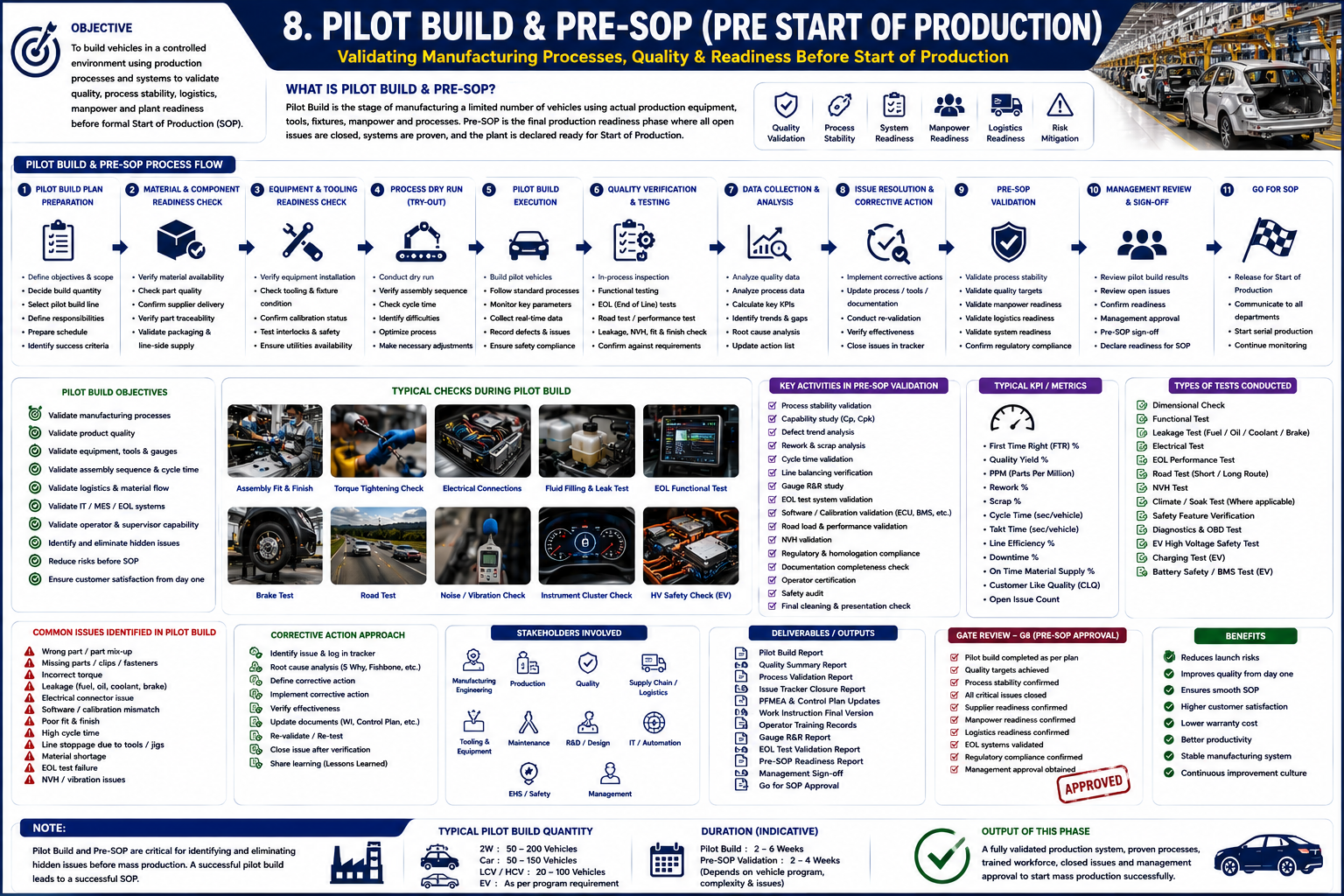
Pilot Build & Pre-SOP in Automotive Product Development
Validating Manufacturing Process, Quality and Production Readiness Before Start of Production
Pilot Build and Pre-SOP are critical stages in the Automotive Product Development Process. After industrialization and production preparation are completed, the manufacturing system must be practically validated before the official Start of Production.
At this stage, the objective is not only to build vehicles, but to confirm whether the plant, processes, tools, equipment, manpower, suppliers, logistics, quality systems and documentation are fully ready for mass production.
In simple words, Pilot Build and Pre-SOP answer the question:
“Can we build production-quality vehicles repeatedly using the actual production process before SOP?”
1. What is Pilot Build?
Pilot Build is the stage where a limited number of vehicles are built using actual or near-final production processes, production tools, fixtures, equipment, manpower and material flow.
The purpose is to validate whether the manufacturing process can produce vehicles that meet quality, functional, safety and compliance requirements.
Pilot Build helps identify hidden issues before SOP, such as:
- Assembly difficulties
- Tooling problems
- Part mismatch
- Supplier quality issues
- Process gaps
- Operator training gaps
- Quality defects
- Cycle time issues
- Logistics problems
- EOL testing failures
A successful Pilot Build gives confidence that the plant can move toward Pre-SOP and final production launch.
2. What is Pre-SOP?
Pre-SOP means Pre Start of Production.
Pre-SOP is the final production readiness phase before official SOP. In this phase, all open production, quality, logistics, supplier, manpower, system and documentation issues are closed.
Pre-SOP confirms that:
Manufacturing processes are stable.
Quality targets are achieved.
Operators are trained.
Suppliers are ready.
Logistics flow is stable.
EOL systems are working.
IT / MES / ERP systems are ready.
Regulatory and homologation requirements are understood.
Management approves readiness for SOP.
3. Objective of Pilot Build & Pre-SOP
The main objective is to build vehicles in a controlled environment using production processes and systems to validate:
- Product quality
- Manufacturing process stability
- Equipment and tooling readiness
- Manpower readiness
- Logistics readiness
- Supplier readiness
- Quality control systems
- EOL testing systems
- Regulatory readiness
- SOP preparedness
The final output is a fully validated production system, proven processes, trained workforce, closed open issues and management approval to start mass production.
4. Pilot Build & Pre-SOP Process Flow
The image shows an 11-step process flow.
Step 1: Pilot Build Plan Preparation
This is the planning stage for the pilot production activity.
Key Activities
Define pilot build objectives and scope.
Decide pilot build quantity.
Select pilot build line.
Define responsibilities.
Prepare production schedule.
Identify success criteria.
Define vehicle configuration.
Confirm production documentation.
Prepare risk assessment.
Why It Is Important
Without a clear pilot build plan, teams may build vehicles without proper objectives, data collection and issue tracking. The pilot build must have measurable targets such as first-time-right quality, defect reduction, cycle time achievement, EOL pass rate and process stability.
Step 2: Material & Component Readiness Check
Before pilot build, all parts and materials must be available and verified.
Key Activities
Verify material availability.
Check part quality.
Confirm supplier delivery.
Confirm part traceability.
Validate packaging and line-side supply.
Confirm latest part revision.
Check critical and safety parts.
Confirm supplier PPAP / approval status.
Typical Issues
- Wrong part received
- Old revision part supplied
- Short supply from supplier
- Packaging damage
- Part mixing
- Missing traceability
- Critical part not approved
Material readiness is essential because even one missing or incorrect part can stop the pilot build.
Step 3: Equipment & Tooling Readiness Check
Production tools, fixtures, gauges and equipment must be ready before the pilot build starts.
Key Activities
Verify equipment installation.
Check tooling and fixture condition.
Confirm calibration status.
Test interlocks and safety systems.
Ensure utilities availability.
Confirm gauges and measuring instruments.
Check torque tools.
Verify EOL test equipment.
Examples
- Assembly fixtures
- Torque tools
- Welding fixtures
- Checking gauges
- Leak test equipment
- Electrical testers
- EOL diagnostic system
- Conveyor system
- Battery handling equipment for EVs
Tooling and equipment issues identified during pilot build must be resolved before SOP.
Step 4: Process Dry Run / Try-Out
Before actual pilot vehicle build, the team conducts a process dry run or try-out.
Key Activities
Conduct dry run.
Verify assembly sequence.
Check cycle time.
Identify process difficulties.
Optimize process.
Make necessary adjustments.
Validate operator movement.
Validate tool access.
Confirm workstation readiness.
Purpose
The dry run helps identify practical issues before actual production vehicles are built.
Examples of issues identified during dry run:
Tool cannot reach fastener.
Operator cannot access component.
Part orientation is confusing.
Work instruction is unclear.
Cycle time exceeds takt time.
Fixture adjustment is required.
Safety hazard is observed.
Step 5: Pilot Build Execution
In this step, pilot vehicles are built using the defined production process.
Key Activities
Build pilot vehicles.
Follow standard processes.
Monitor key parameters.
Collect real-time data.
Record defects and issues.
Ensure safety compliance.
Follow work instructions.
Maintain traceability.
Verify torque, fluid filling and EOL results.
Important Point
Pilot Build should not be treated as normal vehicle assembly. It is a controlled learning activity where every issue must be captured and analysed.
Step 6: Quality Verification & Testing
After pilot vehicles are built, they are checked thoroughly for quality, function and performance.
Key Activities
- In-process inspection
- Functional testing
- EOL testing
- Road testing
- Performance testing
- Leakage testing
- NVH check
- Fit and finish check
- Confirmation against requirements
Typical Checks
- Assembly fit and finish
- Torque tightening
- Electrical connections
- Fluid filling and leak test
- EOL functional test
- Brake test
- Road test
- Noise and vibration check
- Instrument cluster check
- High-voltage safety check for EVs
Quality verification confirms whether the production system can build acceptable vehicles.
Step 7: Data Collection & Analysis
Pilot Build generates valuable production and quality data.
Key Activities
Analyse quality data.
Analyse process data.
Calculate key performance indicators.
Identify trends and gaps.
Conduct root cause analysis.
Update action list.
Review defect pattern.
Compare results with targets.
Typical Data Collected
- Defects per vehicle
- First-time-right percentage
- EOL pass rate
- Cycle time
- Rework time
- Scrap quantity
- Torque failure data
- Supplier defect data
- Road test issues
- Open issue count
Data-based decisions are essential before SOP approval.
Step 8: Issue Resolution & Corrective Action
All issues found during pilot build must be resolved through a structured corrective action process.
Key Activities
Implement corrective actions.
Update process, tools or documentation.
Conduct re-validation.
Verify effectiveness.
Close issues in tracker.
Update work instructions.
Update control plan.
Update PFMEA if required.
Important Point
An issue should not be closed only because a corrective action is planned. It should be closed only after verification confirms that the action is effective.
Step 9: Pre-SOP Validation
Pre-SOP validates complete readiness before final production launch.
Key Activities
Validate process stability.
Validate quality targets.
Validate manpower readiness.
Validate logistics readiness.
Validate system readiness.
Confirm regulatory compliance.
Confirm EOL readiness.
Confirm documentation completeness.
Conduct operator certification.
Conduct final cleaning and presentation check.
Key Focus Areas
- Process capability
- Defect reduction
- Cycle time achievement
- Line balancing
- Gauge R&R
- Software and calibration validation
- Road load and performance validation
- NVH validation
- Safety audit
- Regulatory readiness
Step 10: Management Review & Sign-Off
After Pre-SOP validation, management reviews the complete readiness status.
Key Activities
Review pilot build results.
Review open issues.
Confirm readiness.
Obtain management approval.
Approve Pre-SOP sign-off.
Declare readiness for SOP.
Review Questions
Were pilot vehicles built as per plan?
Are quality targets achieved?
Is process stability confirmed?
Are all critical issues closed?
Are suppliers ready?
Is manpower trained?
Are logistics stable?
Are EOL systems validated?
Is regulatory compliance confirmed?
Management approval is required before the project moves to SOP.
Step 11: Go for SOP
This is the final release for official Start of Production.
Key Activities
Release for Start of Production.
Communicate approval to all departments.
Start serial production.
Continue close monitoring.
Track early production quality.
Monitor supplier performance.
Monitor customer feedback after launch.
After this stage, the product enters the SOP and ramp-up phase.
5. Pilot Build Objectives
Pilot Build is conducted to validate the complete production ecosystem.
The key objectives are:
Validate manufacturing processes.
Validate product quality.
Validate equipment, tools and gauges.
Validate assembly sequence and cycle time.
Validate logistics and material flow.
Validate IT, MES and EOL systems.
Validate operator and supervisor capability.
Identify and eliminate hidden issues.
Reduce risk before SOP.
Ensure customer satisfaction from day one.
6. Typical Checks During Pilot Build
The image highlights important production and vehicle-level checks.
7. Key Activities in Pre-SOP Validation
Pre-SOP is the final confirmation phase before SOP.
Important activities include:
- Process stability validation
- Capability study, Cp and Cpk check
- Defect trend analysis
- Rework and scrap analysis
- Cycle time validation
- Line balancing verification
- Gauge R&R study
- EOL test system validation
- Software and calibration validation
- Road load and performance validation
- NVH validation
- Regulatory and homologation compliance confirmation
- Documentation completeness check
- Operator certification
- Safety audit
- Final cleaning and presentation check
8. Typical KPIs / Metrics
Pilot Build and Pre-SOP should be monitored using measurable KPIs.
KPIs must be reviewed daily during pilot build and Pre-SOP.
9. Types of Tests Conducted
Pilot Build and Pre-SOP may include several types of tests.
10. Common Issues Identified During Pilot Build
Pilot Build is designed to find issues before customers do.
Common issues include:
- Wrong part or part mix-up
- Missing parts, clips or fasteners
- Incorrect torque
- Leakage of fuel, oil, coolant or brake fluid
- Electrical connector issues
- Software or calibration mismatch
- Poor fit and finish
- High cycle time
- Line stoppage due to tools or jigs
- Material shortage
- EOL test failure
- NVH or vibration issues
- Logistics delay
- Operator skill gap
- Documentation mismatch
- Supplier quality defect
These issues must be tracked systematically until closure.
11. Corrective Action Approach
A structured corrective action system is required to resolve pilot build issues.
Corrective Action Flow
Identify issue.
Log issue in tracker.
Conduct root cause analysis.
Define corrective action.
Implement corrective action.
Verify effectiveness.
Update documents.
Re-validate or re-test.
Close issue after verification.
Share lessons learned.
Root Cause Tools
5 Why Analysis
- Fishbone Diagram
- Pareto Analysis
- Fault Tree Analysis
- Process audit
- Supplier investigation
- Data trend analysis
12. Stakeholders Involved
Pilot Build and Pre-SOP require strong cross-functional teamwork.
13. Deliverables / Outputs
The major deliverables of Pilot Build and Pre-SOP are:
14. Gate Review – G8 Pre-SOP Approval
The Pilot Build and Pre-SOP phase ends with G8 – Pre-SOP Approval.
Gate Review Checklist
Pilot build completed as per plan.
Quality targets achieved.
Process stability confirmed.
All critical issues closed.
Supplier readiness confirmed.
Manpower readiness confirmed.
Logistics readiness confirmed.
EOL systems validated.
Regulatory compliance confirmed.
Management approval obtained.
After this gate approval, the project moves to SOP – Start of Production.
15. Benefits of Effective Pilot Build & Pre-SOP
A strong Pilot Build and Pre-SOP process provides major benefits.
16. Typical Pilot Build Quantity
Pilot build quantity depends on vehicle type, program complexity, validation requirement, launch risk and company policy.
Indicative quantities shown in the image are:
For complex EVs, premium vehicles, new platforms or safety-critical programs, the quantity may be higher.
17. Indicative Duration
Duration depends on vehicle program, complexity, supplier readiness and open issues.
If major issues are found, Pre-SOP duration may extend until corrective actions are validated.
18. Practical Example: Motorcycle Pilot Build
For a motorcycle project, Pilot Build and Pre-SOP may include:
- Frame assembly verification
- Engine fitment process
- Fuel tank fitment and leak test
- Brake hose routing confirmation
- ABS modulator fitment
- Wiring harness routing and clipping
- Headlamp and indicator fitment
- Torque verification for safety fasteners
- Chain alignment
- Wheel alignment
- EOL electrical test
- Noise and vibration check
- Road test
- Final fit and finish audit
Common motorcycle pilot issues include harness fouling, brake hose routing error, missing clips, incorrect torque, chain alignment issue, fuel leakage and NVH complaints.
19. Practical Example: Passenger Car Pilot Build
For a passenger car, Pilot Build and Pre-SOP may include:
- Body panel fitment
- Gap and flushness check
- Door opening and closing effort
- Seat and interior fitment
- Wiring harness routing
- Brake fluid filling and bleeding
- Coolant filling
- Wheel alignment
- EOL diagnostics
- Water leak test
- Road test
- NVH check
- Final inspection
- Customer-like quality audit
Passenger car pilot builds require strong attention to fit and finish, water leakage, electrical systems, software configuration and customer-like quality.
20. Practical Example: EV Pilot Build
For an electric vehicle, Pilot Build and Pre-SOP require additional focus on:
- Battery pack installation
- High-voltage cable routing
- HV connector verification
- Insulation resistance test
- BMS software flashing
- Charging system test
- Thermal management filling and bleeding
- Motor and inverter installation
- HV safety interlock
- EMC readiness
- EOL diagnostics
- Range and drivability check
- Fire safety readiness
- Operator HV safety training
EV pilot builds must be carefully controlled because high-voltage safety, battery traceability, software version control and thermal management are critical.
21. Best Practices for Pilot Build & Pre-SOP
To ensure successful Pilot Build and Pre-SOP:
Freeze pilot build configuration before build.
Confirm all parts are latest revision.
Conduct material readiness review before build.
Validate tools, gauges and equipment before build.
Train operators before pilot assembly.
Use final work instructions wherever possible.
Monitor every build station closely.
Capture all issues with photos and data.
Conduct daily issue review meetings.
Use root cause analysis for repeat issues.
Update PFMEA, Control Plan and SOPs after learnings.
Validate corrective actions through re-test.
Track open issues until closure.
Do not proceed to SOP with unresolved critical issues.
Conduct formal G8 Pre-SOP approval review.
Conclusion
Pilot Build and Pre-SOP are the final proving stages before Start of Production. These phases validate whether the complete manufacturing system can repeatedly produce vehicles that meet quality, safety, performance, regulatory and customer expectations.
A successful Pilot Build identifies and eliminates hidden production issues before mass production. A successful Pre-SOP confirms that processes, tools, equipment, suppliers, logistics, manpower, quality systems, EOL systems and documentation are ready for SOP.
The final output of this phase is:
A fully validated production system, proven processes, trained workforce, closed issues and management approval to start mass production successfully.
Key Takeaways
Pilot Build validates production process using actual production systems.
Pre-SOP confirms final readiness before SOP.
Key focus areas include quality, process stability, manpower, logistics, suppliers, EOL systems and regulatory readiness.
Common issues include wrong parts, torque errors, leakage, electrical issues, software mismatch, fit and finish problems and EOL failures.
G8 Pre-SOP Approval confirms readiness to proceed to Start of Production.
A strong Pilot Build and Pre-SOP process reduces launch risk, improves quality from day one and supports smooth SOP.
Reference tables from the source chapter
| Check Area | Purpose |
|---|---|
| Assembly Fit & Finish | Confirm visual quality, gaps, alignment and assembly quality |
| Torque Tightening Check | Confirm safety-critical fasteners are tightened correctly |
| Electrical Connections | Confirm harness, connectors, sensors and ECU connections |
| Fluid Filling & Leak Test | Check fuel, oil, coolant, brake fluid and leakage |
| EOL Functional Test | Confirm vehicle-level functions and diagnostics |
| Brake Test | Validate brake performance and safety |
| Road Test | Confirm drivability, performance and abnormal noise |
| Noise / Vibration Check | Identify NVH issues |
| Instrument Cluster Check | Verify warnings, display, tell-tales and indicators |
| HV Safety Check | Confirm high-voltage safety for electric vehicles |
Reference table 2
| KPI / Metric | Purpose |
|---|---|
| First Time Right (FTR) | Measures vehicles built correctly without rework |
| Quality Yield % | Measures acceptable output from the process |
| PPM | Defects per million parts / opportunities |
| Rework % | Measures vehicles or parts requiring correction |
| Scrap % | Measures rejected material or components |
| Cycle Time | Time required per vehicle |
| Takt Time | Required production pace to meet demand |
| Line Efficiency % | Measures production line utilization |
| Downtime % | Measures equipment or process stoppage |
| On-Time Material Supply % | Measures logistics and supplier reliability |
| Customer Like Quality (CLQ) | Measures customer-facing quality |
| Open Issue Count | Tracks remaining unresolved issues |
Reference table 3
| Test Type | Purpose |
|---|---|
| Dimensional Check | Verify dimensions, gaps, flushness and alignment |
| Functional Test | Confirm all functions operate correctly |
| Leakage Test | Check fuel, oil, coolant and brake fluid leakage |
| Electrical Test | Check wiring, ECU, sensors, actuators and diagnostics |
| EOL Performance Test | Validate vehicle functions at end of line |
| Road Test | Confirm drivability and basic performance |
| NVH Test | Check abnormal noise and vibration |
| Climate / Soak Test | Validate performance under temperature exposure |
| Safety Feature Verification | Confirm ABS, airbags, lighting, warnings, etc. |
| Diagnostics & OBD Test | Confirm fault detection and diagnostic communication |
| EV High Voltage Safety Test | Confirm insulation, HV protection and safe operation |
| Charging Test | Validate EV charging performance |
| Battery Safety / BMS Test | Confirm battery management and safety functions |
Reference table 4
| Stakeholder | Responsibility |
|---|---|
| Manufacturing Engineering | Process readiness, tools, fixtures and layout |
| Production | Vehicle build, manpower and daily execution |
| Quality | Inspection, defect tracking and quality approval |
| Supply Chain / Logistics | Material readiness and line-side supply |
| Tooling & Equipment | Tool, jig, gauge and equipment readiness |
| Maintenance | Equipment uptime and breakdown support |
| R&D / Design | Design issue resolution and engineering changes |
| IT / Automation | MES, ERP, EOL and data systems readiness |
| EHS / Safety | Workplace safety and compliance |
| Management | Review, decision-making and final approval |
Reference table 5
| Deliverable | Purpose |
|---|---|
| Pilot Build Report | Summary of pilot build execution and observations |
| Quality Summary Report | Defect summary, quality performance and trend analysis |
| Process Validation Report | Confirms process stability and capability |
| Issue Tracker Closure Report | Tracks all open and closed issues |
| PFMEA & Control Plan Updates | Updates risk and control documents |
| Work Instruction Final Version | Final operator instructions for SOP |
| Operator Training Records | Confirms trained manpower |
| Gauge R&R Report | Confirms measurement system reliability |
| EOL Test Validation Report | Confirms end-of-line system readiness |
| Pre-SOP Readiness Report | Confirms final production readiness |
| Management Sign-Off | Formal management approval |
| Go for SOP Approval | Approval to start serial production |
Reference table 6
| Benefit | Explanation |
|---|---|
| Reduces Launch Risk | Identifies and eliminates issues before SOP |
| Improves Quality from Day One | Ensures stable quality before customer delivery |
| Ensures Smooth SOP | Confirms production system readiness |
| Higher Customer Satisfaction | Reduces early field complaints |
| Lower Warranty Cost | Prevents production-related defects |
| Better Productivity | Improves cycle time and process stability |
| Stable Manufacturing System | Confirms tools, process, logistics and manpower readiness |
| Continuous Improvement Culture | Builds problem-solving discipline before launch |
Reference table 7
| Vehicle Category | Typical Pilot Build Quantity |
|---|---|
| Two-Wheeler | 50–200 vehicles |
| Passenger Car | 50–150 vehicles |
| LCV / HCV | 20–100 vehicles |
| EV | As per program requirement |
Reference table 8
| Activity | Indicative Duration |
|---|---|
| Pilot Build | 2–6 weeks |
| Pre-SOP Validation | 2–4 weeks |
Frequently asked questions
What is the purpose of a pilot build?
It builds a limited number of vehicles with production-intent resources to expose product, process, tooling, quality, material-flow, and training issues before launch.
What is pre-SOP validation?
It is the final readiness confirmation that processes are stable, defects are controlled, systems and people are ready, and all critical launch conditions are satisfied.
What is required for go-for-SOP approval?
Management reviews the pilot evidence, quality results, process capability, open-issue status, supplier and logistics readiness, compliance, and launch risks.