Concept Development
Chapter 03 · Automotive Product Development
Use the infographic for the process overview, then follow the chapter sections for definitions, activities, deliverables, gate evidence, and implementation detail.
Chapter infographic
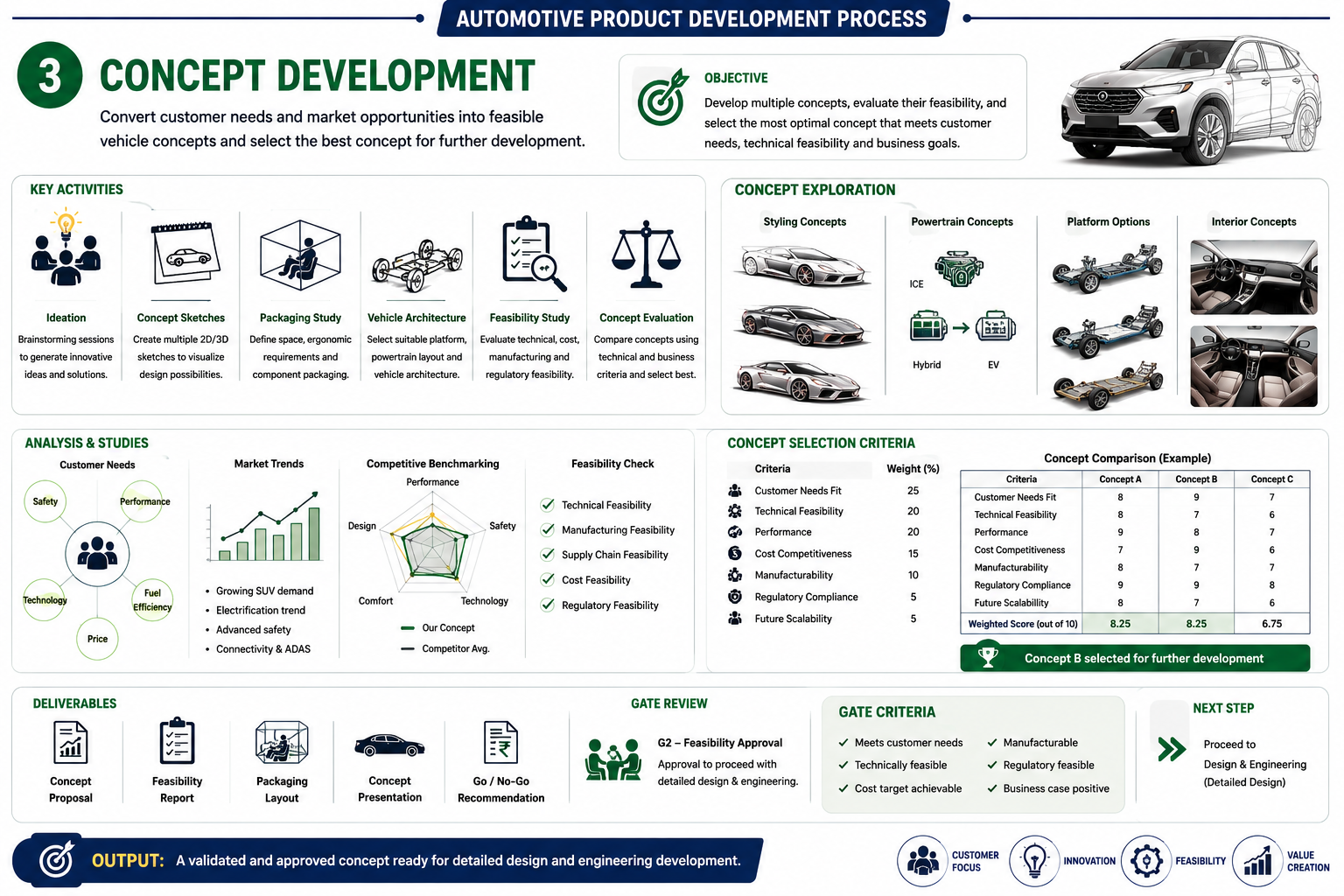
- Automotive Product Development Process
Phase 3: Concept Development
- Complete Engineering Guide to Vehicle Concept Design, Feasibility Analysis & Concept Selection
- Series: Automotive Product Development Process (APDP)
- Level: Professional (OEM, Tier-1 Supplier, Engineering Students)
- Estimated Reading Time: 18–22 Minutes
Introduction
After successfully completing Market Research, Needs Analysis, and Product Planning, the next stage in the Automotive Product Development Process (APDP) is Concept Development.
During this phase, customer requirements, market opportunities, business objectives, and engineering constraints are transformed into one or more feasible vehicle concepts. Designers and engineers collaborate to develop alternative solutions, evaluate their technical and commercial feasibility, and select the most suitable concept for detailed engineering.
Concept Development is a multidisciplinary process involving industrial design, packaging, engineering, manufacturing, quality, procurement, finance, and regulatory teams. Decisions made during this phase influence more than 70% of the total product cost and significantly affect vehicle performance, manufacturability, and customer satisfaction.
What is Concept Development?
Concept Development is the process of creating, evaluating, and selecting the optimal product concept that satisfies:
- Customer expectations
- Business objectives
- Technical feasibility
- Manufacturing capability
- Cost targets
- Regulatory requirements
- Future scalability
It acts as the bridge between Product Planning and Detailed Design & Engineering.
Objectives of Concept Development
The primary objectives are to:
Generate multiple innovative concepts.
Translate customer needs into engineering solutions.
Evaluate each concept using technical and commercial criteria.
Identify manufacturing and supply-chain constraints.
Select the best concept for detailed design.
Reduce development risks before major investments.
- Inputs to Concept Development
The phase begins with approved information from Product Planning:
- Product Vision
- Business Case
- Customer Requirements (VOC)
- Market Research Report
- Competitor Benchmarking
- Regulatory Requirements
- Cost Targets
- Project Timeline
- Target Selling Price
- Technology Roadmap
Key Activities
1. Ideation
Objective
Generate innovative concepts capable of solving customer problems and achieving business goals.
- Typical Activities
- Brainstorming sessions
- Design thinking workshops
- Cross-functional idea generation
- TRIZ methodology
- Innovation challenges
- Supplier innovation workshops
- Participants
- Product Planning
- Industrial Designers
- Mechanical Engineers
- Electrical Engineers
- Manufacturing Engineers
- Marketing Team
- Suppliers
Output
- Initial concept ideas
- Innovation proposals
- Functional concepts
2. Concept Sketches
Concept sketches visualize alternative product ideas before detailed engineering begins.
Activities
- Hand sketches
- Digital sketching
- 2D styling
- 3D rendering
- Exterior styling
- Interior styling
- Ergonomic studies
- Tools
- Adobe Photoshop
- Autodesk Sketchbook
- Alias Auto Studio
- Blender
- CATIA Imagine & Shape
Deliverables
- Exterior styling concepts
- Interior concepts
- Colour & trim concepts
3. Packaging Study
Packaging determines how all vehicle systems fit within the available space while maintaining comfort, safety, and performance.
- Areas Studied
- Driver ergonomics
- Passenger space
- Engine placement
- Battery location (EV)
- Fuel tank location
- Suspension travel
- Wheelbase
- Ground clearance
- Cargo capacity
- Cooling airflow
- Example
For a motorcycle:
- Rider triangle
- Fuel tank volume
- Seat height
- Handlebar reach
- Suspension clearance
4. Vehicle Architecture
Vehicle architecture defines the fundamental layout of the vehicle.
- Decisions
- Platform selection
- Chassis type
- Drivetrain configuration
- Wheelbase
- Suspension layout
- Powertrain type
- Steering system
- Braking system
- Example
- Passenger Car
- Monocoque
- Front-wheel drive
- Hybrid architecture
- Motorcycle
- Trellis frame
- Perimeter frame
- Steel cradle frame
- Aluminium twin spar
5. Feasibility Study
Every concept is evaluated before investment.
- Technical Feasibility
- Engineering capability
- Technology maturity
- Simulation results
- Manufacturing Feasibility
- Existing production line
- Tooling requirement
- Automation level
- Supply Chain Feasibility
- Supplier capability
- Material availability
- Logistics
- Regulatory Feasibility
- AIS
- CMVR
- UNECE
- BS-VI
- EV Safety Standards
- Cost Feasibility
- BOM cost
- Tooling investment
- Manufacturing cost
- ROI
6. Concept Evaluation
Each concept is scored using weighted decision criteria.
Typical criteria include:
A weighted decision matrix helps objectively compare alternatives and supports selecting the strongest concept.
Concept Exploration
Multiple concept directions are usually investigated before final selection.
- Styling Concepts
Evaluate:
- Exterior styling
- Aerodynamics
- Brand identity
- Customer appeal
- Powertrain Concepts
Possible alternatives:
- Internal Combustion Engine (ICE)
- Hybrid Electric Vehicle (HEV)
- Plug-in Hybrid (PHEV)
- Battery Electric Vehicle (BEV)
- Hydrogen Fuel Cell (FCEV)
Evaluation parameters:
- Efficiency
- Performance
- Emissions
- Cost
- Infrastructure
- Future regulations
- Platform Options
Examples
- Existing platform carry-over
- Modified platform
- Completely new platform
- Shared global platform
- Modular architecture
Evaluation includes:
- Cost
- Development time
- Manufacturing complexity
- Scalability
- Interior Concepts
Study:
- Dashboard layout
- Human-Machine Interface (HMI)
- Seating comfort
- Visibility
- Storage
- Premium feel
- Infotainment integration
Analysis & Studies
Customer Needs Analysis
Customer requirements are translated into measurable engineering targets using tools such as the Kano Model and Quality Function Deployment (QFD).
Examples
- Safety
- Performance
- Fuel efficiency
- Comfort
- Technology
- Price
- Market Trends
Typical trends assessed include:
- Growth of SUVs and Crossovers
- Electrification
- ADAS
- Connected Vehicles
- Sustainable Materials
- Subscription Mobility
- Shared Mobility
- Software-Defined Vehicles
- Competitive Benchmarking
Compare competing products for:
- Performance
- Safety
- Cost
- Design
- Technology
- Comfort
- Quality
- Brand positioning
Benchmarking helps identify gaps and opportunities.
- Feasibility Check
Before approval, each concept is evaluated against:
- Technical feasibility
- Manufacturing feasibility
- Supply-chain feasibility
- Cost feasibility
- Regulatory feasibility
- Business feasibility
Only concepts meeting these criteria progress to detailed engineering.
- Concept Selection Process
Most OEMs follow a structured concept selection workflow:
Generate multiple concepts.
Define evaluation criteria.
Assign weights to each criterion.
Score every concept.
Calculate weighted scores.
Conduct risk assessment.
Review with cross-functional teams.
Select the preferred concept.
Obtain management approval.
Deliverables
At the end of Concept Development, the following documents are produced:
- Concept Proposal
- Feasibility Report
- Vehicle Packaging Layout
- Vehicle Architecture Definition
- Styling Review Package
- Engineering Concept Presentation
- Concept Evaluation Matrix
- Go / No-Go Recommendation
- Gate Review – G2 Feasibility Approval
The Concept Development phase concludes with Gate G2, where senior management determines whether the selected concept is ready to proceed into detailed engineering.
The review typically assesses:
Customer needs are satisfied.
Technical feasibility is demonstrated.
Manufacturing capability exists.
Cost targets are achievable.
Regulatory compliance is feasible.
Supply chain is capable.
Business case remains positive.
Project risks are acceptable.
Approval at Gate G2 authorizes the project to enter the Design & Engineering phase.
- Best Practices
Generate several concepts before converging on one.
Include manufacturing and supplier teams early in the process.
Validate concepts using CAD and CAE where possible.
Benchmark leading competitors continuously.
Consider future regulations and electrification trends.
Use objective scoring methods to reduce bias.
Capture assumptions and risks for future reviews.
- Common Engineering Tools
- Challenges in Concept Development
Typical challenges include:
Balancing customer expectations with cost targets.
Selecting emerging technologies with uncertain maturity.
Meeting increasingly stringent safety and environmental regulations.
Managing cross-functional trade-offs.
Ensuring supplier readiness.
Keeping development timelines on track.
Adapting to rapidly changing market trends.
Conclusion
Concept Development is the foundation of successful automotive engineering. By transforming market research and product strategy into technically and commercially viable concepts, this phase establishes the direction for the entire development program.
A disciplined concept development process minimizes technical risk, supports informed decision-making, and enables OEMs to deliver innovative, manufacturable, and customer-focused vehicles that meet future market and regulatory demands.
Key Takeaways
Concept Development bridges Product Planning and Detailed Design.
Multiple concepts should be generated and evaluated before selection.
Decisions made during this phase have a major influence on cost, quality, performance, and manufacturing.
Structured feasibility studies and weighted evaluation matrices improve decision quality.
Cross-functional collaboration is essential to ensure technical, commercial, and regulatory success.
Reference tables from the source chapter
| Criteria | Weight (%) |
|---|---|
| Customer Needs Fit | 25 |
| Technical Feasibility | 20 |
| Performance | 20 |
| Cost Competitiveness | 15 |
| Manufacturability | 10 |
| Regulatory Compliance | 5 |
| Future Scalability | 5 |
Reference table 2
| Category | Tools |
|---|---|
| CAD | CATIA, Siemens NX, Creo |
| Styling | Alias AutoStudio, Blender |
| CAE | ANSYS, Abaqus, HyperWorks |
| Project Management | Microsoft Project, Jira |
| Risk Analysis | DFMEA, Pugh Matrix, Risk Matrix |
| Requirements Management | IBM DOORS, Polarion |
| Collaboration | Microsoft Teams, Confluence |
Frequently asked questions
What is evaluated during concept development?
Teams compare customer fit, technical feasibility, performance, cost, manufacturability, regulatory compliance, and the ability to scale the concept into future variants.
What is a vehicle packaging study?
It checks whether occupants, powertrain, chassis, storage, safety zones, electrical systems, and service spaces can coexist within the intended vehicle dimensions.
When is a concept ready for detailed engineering?
It is ready after the preferred concept has an approved feasibility case, packaging layout, architecture direction, target performance, and clear risks.