Design and Product Validation Testing
Chapter 07 · Automotive Product Development
Use the infographic for the process overview, then follow the chapter sections for definitions, activities, deliverables, gate evidence, and implementation detail.
Chapter infographic
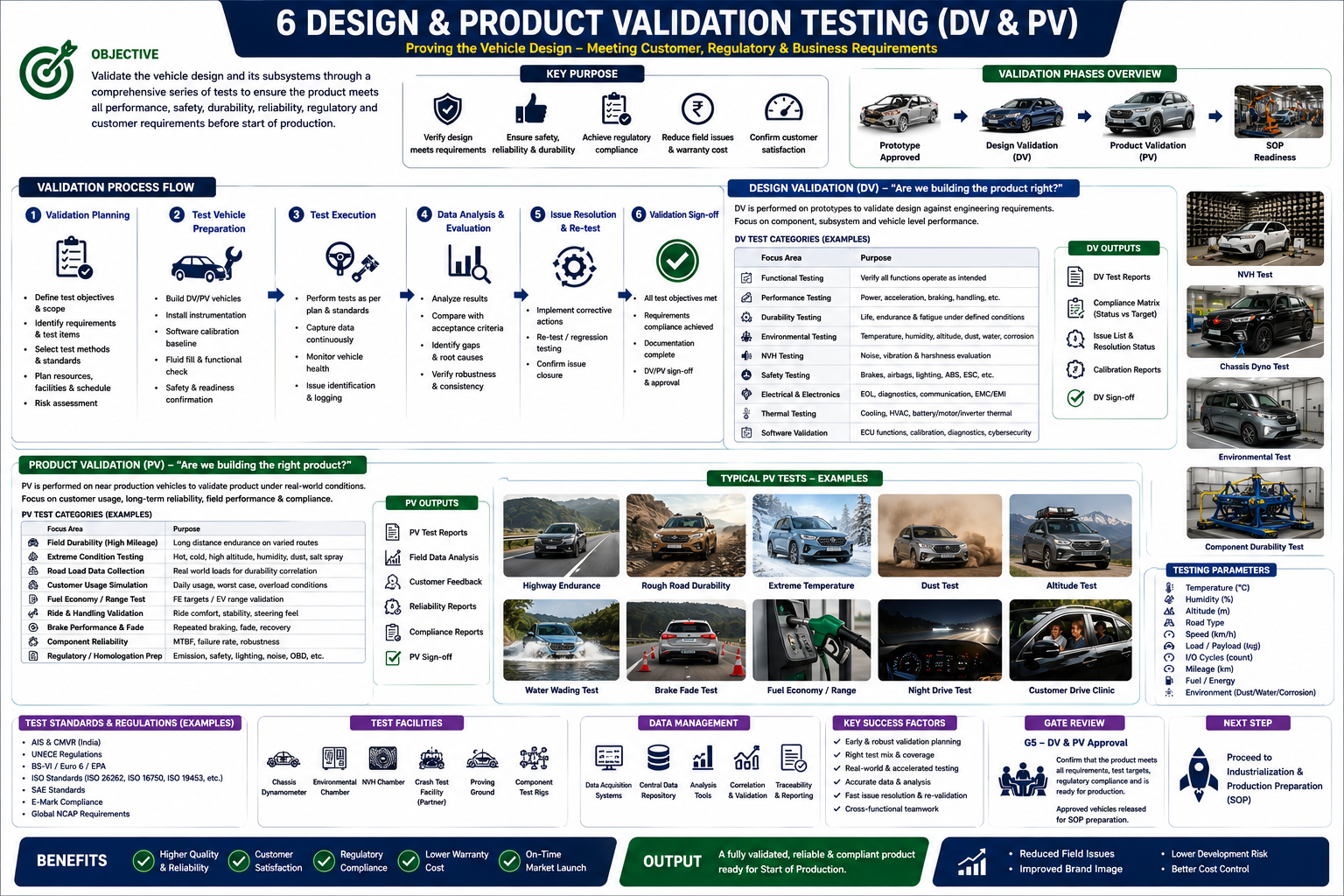
Design & Product Validation Testing in Automotive Product Development
Proving the Vehicle Design Before Start of Production
Design & Product Validation Testing is one of the most important phases in the Automotive Product Development Process. After prototype vehicles are built and approved, they must be tested under controlled laboratory conditions and real-world operating conditions to confirm that the design meets engineering, customer, regulatory, quality, reliability, durability, safety, and business requirements.
This phase ensures that the vehicle is not only technically correct but also suitable for customer use, regulatory approval, and production launch.
For safety-related E/E systems, validation must show that safety goals are achieved at the integrated vehicle level, including fault injection, timing, degraded operation, and safe-state behaviour. Use Functional Safety (FuSa) in Automotive to connect DV/PV evidence with ISO 26262 work products and the safety case.
In simple terms, this phase answers two major questions:
Design Validation (DV): Are we building the product correctly as per engineering requirements?
Product Validation (PV): Are we building the right product for customers and real-world usage?
1. Objective of DV & PV Testing
The main objective of Design and Product Validation Testing is to validate the vehicle design and its subsystems through a comprehensive series of tests before Start of Production.
The vehicle must meet:
- Performance requirements
- Safety requirements
- Durability requirements
- Reliability targets
- Regulatory requirements
- Customer expectations
- Business requirements
- Quality and warranty targets
This phase confirms whether the product is ready to move toward industrialization, production preparation, homologation, and SOP.
2. Key Purpose of Validation Testing
The key purpose of DV and PV testing is to reduce risk before mass production.
Validation testing helps to:
Verify that the design meets engineering requirements.
Ensure safety, reliability, and durability.
Achieve regulatory compliance.
Reduce field issues and warranty costs.
Confirm customer satisfaction.
Identify design weaknesses before production.
Validate system integration.
Confirm readiness for SOP.
A product should not proceed to production only because it is designed well on paper. It must prove its performance through actual testing.
3. Validation Phases Overview
The validation process generally follows this sequence:
Prototype Approved → Design Validation (DV) → Product Validation (PV) → SOP Readiness
Prototype Approved
Prototype vehicles are built and released after initial checks, commissioning, and prototype sign-off.
Design Validation
Design Validation verifies the engineering design against technical requirements.
Product Validation
Product Validation verifies the near-production product under real-world customer usage conditions.
SOP Readiness
After successful DV and PV completion, the product is considered ready for industrialization and production launch preparation.
4. Validation Process Flow
The validation process should follow a structured flow to ensure that all test objectives are completed properly.
Step 1: Validation Planning
Validation planning defines what needs to be tested, how it will be tested, where it will be tested, and what criteria will be used for approval.
Key Activities
Define test objectives and scope.
Identify requirements and test items.
Select test methods and standards.
Plan required test resources.
Prepare test schedule.
Identify required facilities.
Define acceptance criteria.
Conduct risk assessment.
Importance
Poor validation planning can lead to incomplete testing, wrong test conditions, delayed approval, and missed failures. Therefore, every test must be linked to a clear requirement and acceptance criterion.
Step 2: Test Vehicle Preparation
Before testing, the vehicle must be prepared in the correct configuration.
Key Activities
Build DV/PV test vehicles.
Install test instrumentation.
Confirm software calibration baseline.
Complete fluid filling and functional checks.
Confirm safety and readiness.
Verify vehicle configuration.
Confirm latest part revision.
Prepare test logs and documents.
Important Checks
- Vehicle number
- Build level
- ECU software version
- Calibration version
- Part revision level
- Tyre specification
- Fuel or battery condition
- Instrumentation calibration
- Safety inspection status
Test results are meaningful only when the vehicle configuration is properly controlled.
Step 3: Test Execution
Testing is conducted according to approved test plans, standards, and procedures.
Key Activities
Perform tests as per plan and standards.
Capture test data continuously.
Monitor vehicle health.
Identify and log issues.
Maintain test records.
Record environmental conditions.
Follow safety requirements.
Test execution may happen in laboratories, proving grounds, public roads, test tracks, environmental chambers, dynamometers, or special test facilities.
Step 4: Data Analysis & Evaluation
After testing, collected data must be analysed against acceptance criteria.
Key Activities
Analyse test results.
Compare results with acceptance criteria.
Identify gaps and root causes.
Verify robustness and consistency.
Compare with benchmark targets.
Check repeatability of results.
Prepare evaluation summary.
Example
If the braking distance target is 40 meters and the vehicle achieves 43 meters, the result must be investigated. The root cause may be tyre selection, brake pad material, ABS calibration, vehicle weight, or brake balance.
Step 5: Issue Resolution & Re-Test
If any issue is found during validation, corrective action must be taken, and the test must be repeated.
Key Activities
Implement corrective actions.
Update design, software, calibration, or process.
Conduct re-test or regression testing.
Confirm issue closure.
Update issue tracker.
Record change history.
Important Point
An issue should not be closed only because corrective action is planned. It should be closed only after verification testing confirms that the issue is resolved.
Step 6: Validation Sign-Off
After all tests are completed and issues are closed, validation sign-off is given.
Key Activities
Confirm all test objectives are met.
Confirm requirements compliance.
Complete documentation.
Confirm DV/PV sign-off.
Approve the product for the next phase.
Validation sign-off becomes an important input for industrialization, homologation, SOP, and management approval.
5. Design Validation (DV)
What is Design Validation?
Design Validation is performed on prototype vehicles, systems, and components to validate the design against engineering requirements.
DV focuses on component, subsystem, and complete vehicle performance from an engineering point of view.
Main Question
Are we building the product correctly as per approved design and engineering requirements?
DV Test Categories
DV Outputs
At the end of Design Validation, the following outputs are expected:
- DV Test Reports
- Compliance Matrix
- Status vs Target Summary
- Issue List
- Issue Resolution Status
- Calibration Reports
- DV Sign-Off
DV approval confirms that the engineering design is mature enough to proceed further.
6. Product Validation (PV)
What is Product Validation?
Product Validation is performed on near-production vehicles to validate product performance under real-world operating conditions.
PV focuses more on customer usage, long-term reliability, field performance, and production-intent design maturity.
Main Question
Are we building the right product for customers, market conditions, and real-world usage?
PV Test Categories
PV Outputs
At the end of Product Validation, the following outputs are expected:
- PV Test Reports
- Field Data Analysis
- Customer Feedback
- Reliability Reports
- Compliance Reports
- PV Sign-Off
PV approval confirms that the product is suitable for customer usage and ready for production launch preparation.
7. Typical PV Tests
The image highlights several typical Product Validation tests.
Highway Endurance
Used to evaluate long-distance running performance, fuel economy, thermal stability, NVH, and customer comfort.
Rough Road Durability
Used to test suspension, chassis, body, fasteners, brackets, mountings, and structural durability.
Extreme Temperature Testing
Used to validate vehicle performance in hot and cold conditions, including starting, cooling, HVAC, battery performance, and material behaviour.
Dust Test
Used to check air filter performance, sealing, electrical connectors, moving parts, and cabin or component dust ingress.
Altitude Test
Used to verify engine performance, cooling, braking, fuel system, EV range, and calibration behaviour at high altitude.
Water Wading Test
Used to validate water ingress protection, electrical protection, intake position, sealing, and drivability.
Brake Fade Test
Used to confirm brake performance after repeated braking or downhill operation.
Fuel Economy / Range Test
Used to confirm fuel consumption for ICE vehicles and driving range for EVs.
Night Drive Test
Used to check lighting performance, visibility, instrument readability, glare, and driver confidence.
Customer Drive Clinic
Used to collect feedback from target customers regarding comfort, performance, styling, features, usability, and overall satisfaction.
8. Testing Parameters
During DV and PV testing, test conditions must be recorded carefully.
Common testing parameters include:
- Temperature
- Humidity
- Altitude
- Road type
- Speed
- Load / payload
- Input-output cycles
- Mileage
- Fuel / energy consumption
- Dust exposure
- Water exposure
- Corrosion exposure
- Tyre condition
- Vehicle configuration
- Software version
- Calibration version
Accurate recording of these parameters is essential for traceability and repeatability.
9. Test Standards & Regulations
Test standards and regulations vary depending on vehicle category, country, market, and product type.
Common examples include:
- AIS and CMVR requirements for India
- UNECE regulations
- Bharat Stage emission norms
- Euro emission regulations
- EPA requirements
- ISO standards
- SAE standards
- E-mark compliance
- Global NCAP requirements
- Internal OEM engineering standards
For any actual vehicle program, the validation plan must be prepared according to the applicable market and regulatory requirements.
10. Test Facilities
DV and PV testing may require multiple test facilities.
Chassis Dynamometer
Used for emission testing, fuel economy testing, powertrain evaluation, road load simulation, and performance checks.
Environmental Chamber
Used for hot, cold, humidity, altitude, and thermal performance testing.
NVH Chamber
Used to measure and analyse vehicle noise, vibration, and harshness.
Crash Test Facility
Used for frontal impact, side impact, rear impact, pedestrian safety, and occupant protection testing.
Proving Ground
Used for handling, braking, durability, rough road, gradient, water wading, and endurance tests.
Component Test Rigs
Used to test individual parts and systems such as suspension, brakes, seats, doors, battery packs, engine mounts, and chassis components.
11. Data Management
Validation testing produces a large amount of data. Proper data management is necessary for decision-making and traceability.
Key Data Management Elements
Data Acquisition Systems
Used to collect vehicle speed, acceleration, temperature, pressure, vibration, voltage, current, strain, load, CAN signals, GPS data, and other test parameters.
Central Data Repository
All test data, reports, photos, videos, logs, and issue records should be stored in a controlled system.
Analysis Tools
Used for data processing, graphing, comparison, statistical analysis, and failure investigation.
Correlation & Validation
Simulation data and physical test results should be compared to confirm that virtual models are accurate.
Traceability & Reporting
Each test result should be traceable to:
- Requirement
- Test procedure
- Vehicle number
- Part revision
- Test condition
- Acceptance criteria
- Final decision
Good data management prevents confusion during sign-off, homologation, audits, and future issue investigation.
12. Issue Management During DV & PV
Validation testing often identifies failures or performance gaps. A strong issue management process is necessary.
Typical Issue Flow
- Issue identification
- Issue logging
- Severity classification
- Root cause analysis
- Corrective action planning
- Design / software / calibration update
- Re-test
- Regression testing
- Final closure
- Lessons learned documentation
Common Issues Found During DV & PV
- Overheating
- Brake fade
- Noise and vibration
- Water leakage
- Dust ingress
- Electrical failure
- Software malfunction
- Calibration instability
- Structural crack
- Component fatigue
- Poor fuel economy
- Low EV range
- Poor ride comfort
- Handling instability
- Regulatory non-compliance
- Customer dissatisfaction
13. Gate Review – G5 DV & PV Approval
The validation phase ends with G5 – DV & PV Approval.
Purpose of Gate Review
To confirm that the product meets all requirements, test targets, regulatory compliance expectations, and is ready for production preparation.
Review Points
DV tests completed.
PV tests completed.
All critical issues closed.
Open issues reviewed and accepted.
Requirements compliance achieved.
Reliability targets achieved.
Regulatory path confirmed.
Customer feedback reviewed.
Test reports approved.
Product ready for SOP preparation.
After G5 approval, approved vehicles are released for SOP preparation and the project proceeds to:
Industrialization & Production Preparation
14. Key Success Factors
Successful DV and PV testing depends on:
- Early and robust validation planning
- Right test mix and coverage
- Real-world and accelerated testing
- Accurate data analysis
- Fast issue resolution and re-validation
- Cross-functional teamwork
- Strong test vehicle configuration control
- Clear acceptance criteria
- Proper instrumentation
- Reliable test facilities
- Effective supplier involvement
15. Benefits of Effective DV & PV Testing
Effective validation testing provides major benefits to the complete product development program.
16. Practical Example: Motorcycle DV & PV Testing
For a motorcycle project, DV and PV may include:
- Engine performance test
- Brake and ABS test
- Emission pre-check
- Noise test
- Lighting check
- Ride and handling evaluation
- Suspension durability
- Frame fatigue test
- High-speed stability
- Gradeability test
- Water splash test
- Dust test
- Hot and cold start test
- Fuel economy test
- Rider comfort evaluation
- Electrical and diagnostic check
For motorcycles, special attention is required for braking, lighting, emissions, noise, ABS, frame durability, heat protection, wiring harness routing, and customer ride feel.
17. Practical Example: EV DV & PV Testing
For an electric vehicle, DV and PV may include:
- Battery performance test
- Battery cycle test
- Thermal runaway safety evaluation
- Motor performance test
- Inverter cooling test
- Charger performance test
- High-voltage safety check
- Insulation resistance test
- EV range test
- Regenerative braking validation
- EMC test
- BMS software validation
- Charging compatibility test
- Water ingress test
- Customer range simulation
EV validation requires strong coordination between mechanical, electrical, electronics, software, thermal, safety, and regulatory teams.
18. Common Risks in DV & PV Testing
Typical risks include:
- Incomplete validation plan
- Wrong vehicle configuration
- Missing instrumentation
- Incorrect test procedure
- Poor data recording
- Delayed issue closure
- Supplier part failure
- Software mismatch
- Calibration delay
- Inadequate environmental testing
- Underestimated customer usage
- Late regulatory interpretation
- Insufficient sample quantity
- Weak traceability
- Delayed re-testing
These risks must be managed through validation planning, readiness reviews, issue tracking, and management gate reviews.
19. Best Practices for DV & PV Testing
Prepare the validation plan early.
Link every test to a requirement.
Define clear acceptance criteria.
Confirm test vehicle configuration before testing.
Use calibrated instruments.
Record environmental and vehicle conditions.
Conduct safety checks before every test.
Monitor data continuously.
Log all issues immediately.
Use structured root cause analysis.
Repeat tests after corrective action.
Maintain complete traceability.
Review progress regularly with cross-functional teams.
Obtain formal DV and PV sign-off before production preparation.
Conclusion
Design and Product Validation Testing is the proof stage of vehicle development. It confirms whether the design works as intended and whether the product is suitable for real-world customer usage.
Design Validation focuses on engineering requirements, component performance, subsystem reliability, and design robustness. Product Validation focuses on real-world performance, customer usage, durability, field reliability, and production readiness.
A disciplined DV and PV process reduces field failures, improves quality, supports regulatory compliance, lowers warranty cost, and increases customer satisfaction.
The final output of this phase is:
A fully validated, reliable, and compliant product ready for Start of Production preparation.
Key Takeaways
DV validates the engineering design.
PV validates the near-production product under real-world conditions.
Validation planning, test execution, data analysis, issue closure, and sign-off are core steps.
Both laboratory and field testing are required.
Data traceability and configuration control are essential.
G5 DV & PV Approval confirms readiness for industrialization and production preparation.
Reference tables from the source chapter
| DV Test Category | Purpose |
|---|---|
| Functional Testing | Verify that all functions operate as intended |
| Performance Testing | Check power, acceleration, braking, handling, and response |
| Durability Testing | Validate life, endurance, and fatigue under defined conditions |
| Environmental Testing | Check performance under temperature, humidity, altitude, dust, water, and corrosion |
| NVH Testing | Evaluate noise, vibration, and harshness |
| Safety Testing | Validate brakes, airbags, lighting, ABS, ESC, and safety-related systems |
| Electrical & Electronics Testing | Check EOL, diagnostics, communication, EMC, and EMI |
| Thermal Testing | Validate cooling, HVAC, battery, motor, inverter, and thermal performance |
| Software Validation | Check ECU functions, calibration, diagnostics, cybersecurity, and control logic |
Reference table 2
| PV Test Category | Purpose |
|---|---|
| Field Durability / High Mileage | Long-distance endurance on varied routes |
| Extreme Condition Testing | Hot, cold, high altitude, humidity, dust, salt spray |
| Road Load Data Collection | Real-world load data for durability correlation |
| Customer Usage Simulation | Daily usage, worst-case usage, overload conditions |
| Fuel Economy / Range Testing | Fuel economy targets or EV range validation |
| Ride & Handling Validation | Ride comfort, stability, steering feel, handling behaviour |
| Brake Performance & Fade | Repeated braking, brake fade, recovery, ABS behaviour |
| Component Reliability | MTBF, failure rate, system robustness |
| Regulatory / Homologation Preparation | Emission, safety, lighting, noise, OBD, and other compliance checks |
Reference table 3
| Benefit | Explanation |
|---|---|
| Higher Quality & Reliability | Reduces failures before production |
| Customer Satisfaction | Confirms real-world usability and performance |
| Regulatory Compliance | Supports type approval and homologation readiness |
| Lower Warranty Cost | Prevents field failures and repeated complaints |
| On-Time Market Launch | Reduces late-stage failures and delays |
| Reduced Field Issues | Identifies failures before customer delivery |
| Improved Brand Image | Launches a mature and reliable product |
| Better Cost Control | Avoids expensive corrections after production |
Frequently asked questions
What is the difference between DV and PV?
Design Validation checks whether the engineering design meets its requirements. Product Validation checks whether production-intent vehicles satisfy customer and real-world usage expectations.
What is a DVP&R?
The Design Verification Plan and Report defines each requirement, test method, sample, condition, acceptance criterion, result, status, and approval record.
Why is correlation important in validation?
Correlation connects simulation, bench, proving-ground, and field results so teams can trust models, understand variation, and avoid false conclusions.